
“If you say that you are an Athenian or a Corinthian, you are wrong. You are a citizen of the world. “ (Epictetus, Discourses 1.9.1)
This essay explores Stoic ethics as a philosophical framework for understanding contemporary migration, that being the personal and societal moral tensions it evokes. The structure suggests five interconnected themes, moving from the micro-level of individual experience to broader ethical-cosmopolitan implications. The discussion begins with the origins of migration and the Stoic foundations of cosmopolitanism, followed by an examination of Nature and the Self, the four cardinal virtues, and the Stoic concept of social oikeiosis (moral affiliation). In the final section, I propose a Stoic model, aiming towards resolving this tension, based on the Discipline of Assent, using the metaphor of Foucault’s Pendulum, illustrating how emotion and virtue oscillate around a constant axis of reason.
Drawing on both classical Stoicism and contemporary migration studies, I frame and challenge the central question that being: “What does it take to migrate virtuously?” I trace the ethical terrain shaped by human movement, natural law, oikeiosis, and the Stoic pursuit of justice. After all, as Cicero writes in the De Officiis 1.22: “We are not born for ourselves alone… but for the sake of human society.”
We are witnessing very complex socio-economic moral dilemmas spanning far beyond borders. Multiple push and pull factors weigh in the decision-making, policy drafting, rules and regulation establishments, whilst balancing the fine act of correct political and economic involvement. Compassion and control, openness and order. But is migration only about governmentality and management? (Casas, Cortes en al, 2015). The debate over migration brushes far up on from the rationality behind safeguarding security, whilst introspectively grasping the two very important boundaries – the physical and psychological ones, on the self and on the collective. The give and take, the sacrifices and at the same time differently charged consequences. What is the role of the individual and societal norms in setting the ethical parameters of those boundaries? Are migration policies, unions and history overall set a perspective to the influx?
- Origins of Migration & Cosmopolitanism
Epictetus, in his Discourses, claimed that we are all citizens of the world. In equal terms, one might propagate that this brings about the topic to a unitary front, namely the universality of the human condition of global citizenship. Yet, in reality, migration remains clouded by fear, exclusion, and political uncertainty—drifting away from the core of Stoic ethics. That being grounded in virtue, rational self-governance, and moral responsibility. Types of migration, the diversity of motivations and goals—how much of it reflects a natural human impulse, and how much is an “experience of the course of natural events” (Inwood, 2003)? These are the questions this essay seeks to unpack, guided by the ancient yet enduring wisdom of the Stoics.
Humans have always moved, seeking food, safety, opportunity and freedom. From early, nomadic movements to today’s digital nomads crossing borders for opportunity, migration has always been a defining feature of human existence. Throughout the ages, contextually changing reinforcement tied migration to a rich array of cultural exchange, enrichment and empire-building, vast trade, but also carried along geo-political conflicts and wars. Despite its varied forms, migration consistently arises from shared human motivations – needs that transcend geography and time.
In the annals of ancient Stoic movement of people, one might find many forms of migration. In his famous quote, Marcus Aurelius extrapolated on the natural movement of people as: “My city and state are Rome as Antoninus. But as a human being? The world.” (M. Aurelius, Meditations 6.44). Early accounts of cosmopolitanism and Nature. More examples, in his teachings, Epictetus often addresses exile, a form of forced migration. It could be considered that Epictetus’ life offers a good coverage of the “inner” and “outer” migration. The ancient philosopher was born into slavery and later exiled from Rome from Emperor Domitian. In one of his writings, he claims: “Are you exiled from your country? Very well, so too was Diogenes, and yet he lived in exile and was happy.” ( Epictetus, Discourses I.9). In the Stoic spirits, one may deduct that the rational framing of cosmopolitism and “virtue as the only good” claim their parts.
Modern times offer us a more elaborate view on migration factors, according to contemporary research sources, split between four broad domains: environmental displacement, family reunification, refugees, and labor opportunities. Broken down to some of the most vivid movements of people are many urban migrations, refugee crisis, resettlements and deportations. In that sense, migration remains as a quite compartmentalized theme, led by a bureaucratic approach, rather than a deeper grasp of its existential and ethical dimensions. A prominent, though not so recent example is the “long summer of migration” in 2015, a term coined by Kasparek and Speer, when Europe saw more than one million people arrive in search of safety, dignity, and opportunity, pushing the moral agency to its extremes (Kasparek & Speer, 2015). While widely viewed as an unprecedented crisis, it echoes historical moments—such as the “Migration Period”, exemplifying mass migrations around from 375 AD until 600 AD, which contributed to the fall of the Western Roman Empire for example. In both cases, large-scale human movement was driven by geopolitical instability, environmental pressures, and economic hardship. History tends to repeat itself indeed. People’s intentions, too.
How does Stoic ethics link to mass migration? Amidst the political and academic discourse on migration, a deeper philosophical thread persists: cosmopolitanism—the idea that all human beings belong to a single moral community. This notion has its roots in Stoic ethics, where the rational order of the cosmos is mirrored in human nature. The Stoics believed that reason connects all individuals, transcending national or tribal allegiances. From Zeno to Marcus Aurelius, the Stoic ideal of oikeiosis—the process of recognizing others as extensions of oneself—offered a vision of belonging not based on blood or borders, but on shared rationality and moral capacity, such as I will cover in part II.
- Nature & the Self: inner and outer migration: Is migration a preferred indifferent?
In Stoic thoughts, is where we live a preferred indifferent — and how does migration test our ability to remain virtuous amid external change? The below passages will attempt to unpack this statement in Stoic terms, neutrally.
This apparent neutrality, however, is introduced first by Zeno of Citium and refined by the Stoic concept of kathekon—the “fitting” or appropriate action relative to one’s circumstances. As Diogenes Laertius records, a kathekon is that which, when performed, “admits of a reasonable justification.” (Lives of the Eminent Philosophers. 7.107). Migration, then, cannot be evaluated solely as a preferred indifferent. Rather, it must be assessed as a situated action undertaken by rationality responding to external pressures such as threat, deprivation, or the collapse of civic order, for example. When undertaken to preserve life, fulfill familial obligations, or sustain the conditions necessary for virtuous activity, migration may constitute not merely a permissible choice, but a Stoically appropriate response to fortune.
For Stoics, the ruling principle of “living according to nature” is pivotal to its exemplarity. Chrysippus (as cited in Inwood, 2003) emphasized that our individual nature is a fragment of the universal nature. Ethical action then is about aligning the personal will with the rational order of the cosmos. However, this raises a question – is migration in itself ethically neutral or preferred indifferent?
At first glance, migration appears to be a morally indifferent act. Whether voluntarily or forcibly, this act could be unpacked in the following proposition: the act of migration does not come with any ethical obligations. On the one hand, moving from one place to another is individual liberty, choice, and interest. On its own migration is not harmful to others. Thus, unless harm is inflicted, there may not be any moral duty to anyone. On the other hand, every migrant carries along with their possible actions rooted in peculiar ethical implications, both on an individual and group level. In spite of the wholeness and reciprocity, there is asymmetry even to those devoted to inner virtue confronting ethical tension – between individual interest and collective justice, between self-preservation and moral duty toward others. Thus the tension between self-preservation and moral duty gets nullified if one concludes that it is a preferred indifferent.
- Virtues, perception & motivation
The Stoics recognized four cardinal virtues: wisdom, temperance, justice and courage. Justice occupies a central place. The virtue of justice, as the “source of all other virtues” as put by Marcus Aurelius (Meditations. 11.10).
In the context of migration, justice becomes a contested terrain. Migrants, and people, act under emotional pressure. On one hand, migrants may act from a desire to preserve dignity, escape violence, or improve their condition—motivations aligned with virtue. On the other hand, states often enforce border controls or exclusionary policies in the name of national interest. Here lies a deep ethical conflict: How should personal virtue—especially justice—be reconciled with collective policies that may be unjust? The multitude of pressure to resolve this has been reflected upon in some countries – migration policies do differ and there isn’t one solution to them all. According to Stoicism, true justice cannot be reduced to the legality of a policy. The concept of kathekon allows for morally appropriate action even in non-ideal psychological and socio-economic conditions, so long as reason retains a guiding role. A migrant acting from fear may still act fittingly, just as a polity acting under uncertainty may still bear responsibility for justice.
Migratory decisions are frequently shaped by fear, trauma, hope, loss, and desire—affective forces that appear to resist purely rational calculation. Yet this tension between reason and emotion should not be reduced to a simple opposition. Rather, it invites a deeper psychoanalytic interrogation of the subject who migrates. Stoicism assumes that ethical action requires the rational evaluation of impressions; psychoanalysis complicates this assumption by questioning how transparent those motivations are to the conscious subject. Hereunder some contemporary thoughts from Freud and Lacan which depict these dynamics.
From a Freudian perspective, human action cannot be fully understood through conscious intention alone. In The Ego and the Id (1923), Sigmund Freud argues that the ego is not sovereign within its own house; it is structured by unconscious drives, conflicts, and identifications. Migration, in this light, may be interpreted not solely as a strategic response to external conditions, but as a displacement shaped by unconscious desires, repetitions, and unresolved attachments.
Jacques Lacan radicalizes this insight by reconceptualizing subjectivity as constituted through lack and desire. Lacan famously formulates the proposition that “man’s desire is the desire of the Other” (The Four Fundamental Concepts of Psychoanalysis, p. 235). Lacan posits that desire is the desire of the Other, structured within the symbolic order of language. If we are to interpret and position the topic within, migration may therefore be read not merely as economic or political relocation, but as a movement within the symbolic field—a quest for recognition, for inscription within a different “Other,” or for access to a fantasized completeness elsewhere. The migrant subject may pursue not simply material stability, but an imagined wholeness promised by the social and symbolic order of another place.
Thus, migration emerges as both geopolitical and psycho-somatic. It is at once a rational response to material conditions and an existential journey shaped by unconscious desire, identification, and the search for belonging. Rather than opposing Stoic rationality to psychoanalytic desire, we might say that migration exposes the fragile boundary between reason and affect, revealing the subject as divided, motivated by forces that exceed conscious deliberation.
Virtue, in this light, must be then understood not only as an ideal but as a practice that evolves in response to inner and outer conditions. A migrant may act from courage even when driven by fear; they may embody justice even in unjust systems.
- Social oikeiosis and Moral Responsibility
“What injures the hive injures the bee.” (Meditations 6.54)
Later Stoic thinkers, particularly Hierocles, developed the idea of social oikeiosis as an expansion of concern from the self through family and community toward humanity as a whole. Hierocles visualized this through concentric circles, beginning with the self and radiating outward to encompass all of humankind (Stobaeus, Eclogae 4.27.23). Moral progress involves drawing these circles closer, seeing others not as strangers, but as extensions of ourselves.
In the context of migration, this model offers a compelling ethical challenge: How far are we willing to extend our circle of concern? Do we act from virtue, or from vice—fear, greed, prejudice—when confronting migration’s ethical questions? Do our policies reflect an inner commitment to justice, or merely a protective reflex to preserve comfort?
As cosmopolitan citizens, we are called to recognize moral proximity beyond political boundaries. The tension between protecting one’s own and engaging the “other” reflects the Stoic challenge of balancing inner tranquillity with social obligation. Even if national interest demands control, Stoic ethics demands reflection: Are we guided by reason, or by pure impulse? Migration, viewed through Stoic ethics, is not a threat—it is a test, an opportunity of virtue, of courage, of justice. Moreover, it is in itself a try-out on whether we truly live according to nature—not the nature of borders or identities, but the nature of moral beings and rational decision-making and atonement.
- Stoic Discipline on Assent & Foucault’s Pendulum
Drawing upon the intersections explored above—between self and community, emotion and reason, vice and virtue—this final section culminates in a Stoic-inspired model of migration. This model seeks to illuminate how migration, though often framed politically or legally, is at its core a moral act, rooted in personal decision-making, universal reason (logos), and shared human dignity. The model aims to base itself on the Stoic Discipline of Assent, central to the stoic moral psychology in consciously registering impressions, appearances and thoughts. As a guiding metaphor, Foucault’s Pendulum is being considered, not merely for its great motion, but for its constancy amid apparent change and external factors.
Originally designed to demonstrate the Earth’s rotation, Foucault’s Pendulum appears to change direction as it swings, though the pendulum itself remains constant—suspended by a single point, responding not to surface movements, but to a deeper, universal force. In the context of migration and Stoic ethics, the pendulum symbolizes the constancy of reason and natural law, around which the social and political world appears to shift, along with the vast movement of people. The swing represents the ongoing flow of impressions like fear, trauma, hope, or displacement—but if rooted in reason and virtue, their motion is aligned with a larger, rational cosmos. The receiving society, likewise, may oscillate between compassion and fear, openness and protectionism—but its moral integrity is measured by how well it aligns with the unchanging axis of justice.
The metaphor also allows for multiple pendulums: the migrant and the receiving society each oscillate within their own moral contexts. Their interactions may clash or harmonize depending on how each responds to impressions. The migrant’s experience of dislocation, suffering, or hope becomes ethically significant only when assent is given to these impressions—turning raw emotion into virtuous action. Likewise, the receiving society must evaluate its own impressions (fear of the outsider, compassion, economic concern) through reason before responding. In both cases, action must be measured not by reaction, but by rational alignment with justice and cosmopolitan ethics.
Thus, migration is framed not as an external or passive event, but as a moral exercise in navigating impressions, assenting wisely, and acting justly. The pendulum reminds us: though the world may appear in flux, the ethical axis of virtue remains constant.
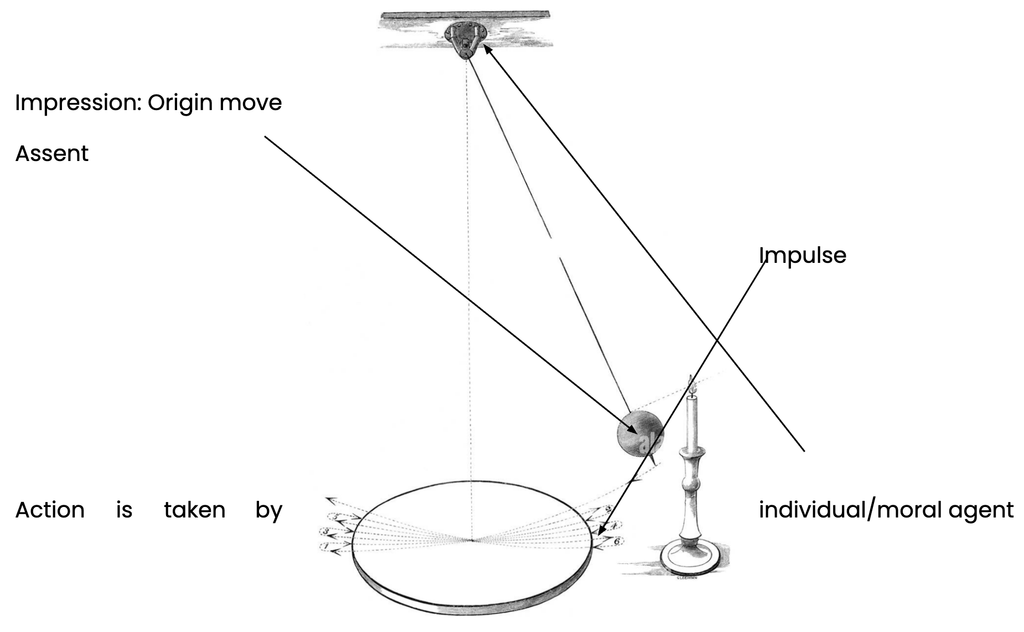
Legend:
Impression (swing begins): triggered by emotion, trauma, hope, need.;
Assent or Withholding (suspension point): the point of rational choice; virtue governs here.;
Impulse (swing continues or adjusts): motivated by reasoned judgment, not raw emotion.;
Action (arc of motion): ethical behavior aligned with logos and justice.
- Concluding Thoughts
My intention in writing this essay was to dissect the complex, yet intricate aspects of the phenomenon of migration, seen as a controlled pure human (counter) reaction to an event, rooted in Nature. Starting from the individual experience to broader questions on cosmopolitanism, social responsibility and justice. I have learned throughout this research that stoicism transcends every boundary. It also oscillates in many directions, primarily between the self and the rest. Embedding Stoicism then as a pendulum in migration ethics is more than bureaucratic necessity – it is vital for the philosophical narrative.
Geographic boundaries often weigh less than the actual intrinsic motives. Cosmic citizenship and cosmopolitanism have been altogether initially interpreted by me differently, albeit their capacity to be viewed as an opportunity to do good and continuously exercise one’s virtues.
In a world increasingly defined by migration, conflict, and displacement, Stoic ethics offers a powerful framework for moral reflection. It reminds us that while laws and borders may govern behavior, it is virtue that governs the soul. Migration, then, becomes more than a demographic trend—it becomes a mirror reflecting our deepest values. As members of a shared moral cosmos, we are challenged not to retreat into narrow self-interest, but to live expansively, justly, and in accordance with nature. The Stoic ideal of cosmopolitanism does not deny political reality—but it insists that beneath every passport is a rational being deserving of dignity.
Aurelius, M. (2011). Meditations: With Selected Correspondence (R. Hard, Trans.). Oxford University Press.
Casas-Cortes, M., Cobarrubias, S., De Genova, N., Garelli, G., Grappi, G., Heller, C., Hess, S., et al. (2015). “New keywords: Migration and Borders.” Cultural Studies, 29(1), 55–87. https://doi.org/10.1080/09502386.2014.891630
Cicero. (2023). De officiis. De Gruyter.
Diogenes Laertius. (2018). Lives Of The Eminent Philosophers (P. Mensch, Trans.; J. Miller, Ed.). Oxford University Press.
Epictetus. (2014). Discourses, Fragments, Handbook (R. Hard, Trans.). Oxford University Press.
Freud, S. (1923). The Ego And The Id. Oxford University Press.
Hadot, P. (2022). The Inner Citadel: The Meditations Of Marcus Aurelius. (M. Chase, Trans.). Harvard University Press.
Heather, P. (2023) Migration and the End of an Empire. Yale University Press.
Inwood, B. (Ed.). (2003). The Cambridge Companion to the Stoics. Cambridge University Press.
Kasparek, B. & Speer (2015) Europas Grenzen: Flucht, Asyl und Migration. Eine kritische Einführung. Bernd Kasparek.
Khan Global Studies. (n.d.). Migration: Definition, Types, Causes and Its Impacts. Khan Global Studies Blogs.
Lacan, J. (1973). The Four Fundamental Concepts of Psychoanalysis. (Seminar XI). The Paris Seminars.
Proudfoot, M., & Lacey, A. R. (Eds.). (2009). The Routledge Encyclopedia of Philosophy. Routledge.
Sellars, J. (2014). Stoicism. Routledge.
Seneca, L. A. (2016). Letters from a Stoic. (R. M. Gummere, Trans.). Dover Publications.
School of Physics, University of New South Wales. (2016). “The Foucault pendulum.” https://www.animations.physics.unsw.edu.au/jw/foucault_pendulum.html
Staszewski, W. (2021). “Causes Of Contemporary Migrations.” Journal of Eastern Europe Research in Business and Economics, 2021, Article 325285.
Stephens, O. (2020). Refugees, Stoicism And Cosmic Citizenship. Pallas, 112.
Stobaeus. (1958). Ioannis Stobaei Anthologium. (C. Wachsmuth & O. Hense, Eds.). Weidmann.