The Rise in Popular Interest in Stoicism
Stoic philosophy, which was first conceptualized by Zeno of Citium in about 300 BCE, is a comprehensive philosophical system that addresses logic, physics and ethics, which it posits to be a complete guide to living a virtuous life. Stoicism integrates reason and self-discipline to cultivate resilience, emphasizing that happiness (eudaimonia) arises from virtue rather than external circumstances. It offers practical techniques for emotional regulation, such as the dichotomy of control, while its cosmology provides a rational framework for understanding nature’s Providential order. Its ethical teachings promote justice, courage, temperance, and wisdom, making it applicable across all aspects of life. As a holistic, practiced or lived philosophy, it remains timeless, guiding individuals toward tranquility and moral integrity amidst life’s challenges. Stoicism has also been referred to as a rational approach to spirituality.
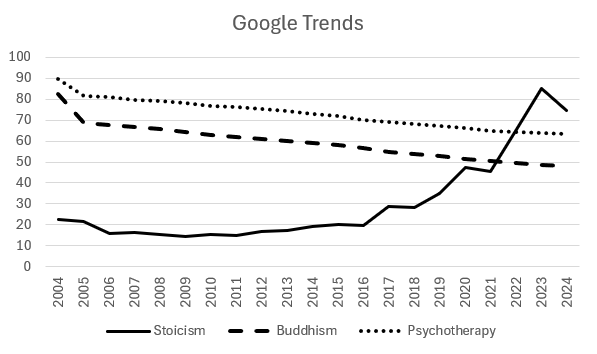
Over the past two decades, there has been a rapid resurgence of interest in Stoicism. Google Trends provides access to a largely unfiltered sample of actual search requests made to Google from 2004 up to 72 hours before the present moment.1 In the case of Stoicism, Google Trends indicates that from 2016 to 2024, searches for “stoicism” have steadily grown, increasing by approximately 350%. In contrast, searches for both “Buddhism” and “psychotherapy” have steadily declined since Google began maintaining trend statistics in 2004.
Other measures show robust and growing interest in Stoicism. Stoic book sales have increased across the board; Marcus Aurelius’ Meditations experienced a 28% rise in print sales from 2019 to early 2020, and Seneca’s Letters to Lucilius saw a 42% increase during the same period.2 New book titles on Stoicism by contemporary authors are appearing weekly. Stoicism has also grown dramatically on social media. The r/Stoicism subreddit hosts over 650,000 members,3 and exemplifies a thriving online community that engages in discussions about Stoic principles and their practical applications. Similar Stoic groups with tens of thousands of members exist on Facebook, Discord and other media. Courses, seminars and workshops abound.
One may wonder, then, why the sudden growth in interest in Stoicism? This paper does not presume to provide the definitive answer to this complex question. What we will do, however, is to characterize – for the first time – the formative experiences shared by a large sample of adults who have subsequently decided to undertake a purposeful educational program of Traditional Stoic philosophy at The College of Stoic Philosophers. Along the way, we will also explore the influence of Buddhism and psychotherapy (as well as other religious, philosophical and therapeutic practices) on the uptake of Stoicism. Finally, we hope to provide a partial answer to the question of what is drawing people to Stoicism in our contemporary world.
The College of Stoic Philosophers: A Unique Sample Population
The College of Stoic Philosophers (“COSP” or the College) was founded in 2008, as the first contemporary institution dedicated exclusively to the study and practice of the Stoic philosophy. The College is explicitly committed to a “Traditional” Stoic curriculum, including the three traditional topoi: logic, physics and ethics. Stoic “physics” implicates a theological perspective because their understanding of nature inherently includes a divine, rational principle governing all things, making their philosophy both scientific and religious in nature. What this means is that students who apply to the College may not be fully comparable to those who identify with “Modern Stoicism” and its own distinctive, non-theistic orientation. Applicants to the College, it should be noted, self-select to engage in a rigorous and Traditional Stoic education.
The College is operated by a 501(c)(3) not-for-profit charitable organization, The Foundation for Stoic Philosophy. The College has developed a highly structured, mentored, online curriculum with which students and faculty engage as a community of practice. Somewhat unusual for most institutions, the College’s faculty is entirely composed of its own graduates. Tuition fees are kept to a minimum (US $100 for the introductory course), and all faculty are volunteers. Students are primarily adults, age 18 and above, though the College does run a very small Stoic preparatory program for teenagers.
From the College’s founding in 2008 through the end of 2023, 471 students enrolled in 832 individually mentored course sessions. Students typically begin with a 4-month introductory course, Stoic Essential Studies. Students who successfully complete that course may then progress to the year-long Marcus Aurelius Program. A growing range of additional courses are also being offered.
A Unique Data Source
The College has always required prospective students to write an autobiographical Know Thyself Essay of at least 1,000 words as part of the application process for Stoic Essential Studies. In this essay, applicants are asked to describe significant life events, their philosophical journey, and religious beliefs, if any. The following additional questions are provided to applicants as essay prompts:
- How long have you been interested in Stoicism?
- Books you have already read on Stoic philosophy, if any.
- Would you call yourself an atheist, agnostic, skeptic, deist, theist, pantheist, or something else?
- Have you studied philosophies other than Stoicism? If so, which?
- Do you consider yourself to be a Stoic?
- What specifically do you want to get from this course?
The College reviewed the records of all applicants from 2008 through 2023, and identified 390 complete student cases – that is, which included the Know Thyself Essay, the student’s subsequent academic record, and their relevant demographic information. Analysis of these essays provides unique insights into prior beliefs, experiences, and motivations of a large number of adults embarking on a rigorous interaction with traditional Stoic philosophy.
Methodology
Each essay was held in the College’s application archive as a separate file. In order to preserve the anonymity of students and to reduce coding bias that might otherwise enter into the analysis, the College employed a custom-developed Python program to i) scrub personal identifiers from each essay, ii) assign a unique identifier (UID) to each case, and iii) create a demographic data file of UIDs and associated demographic data drawn from applications. This data file, along with the scrubbed essays were then loaded into NVivo, a software program specifically designed for the analysis of unstructured data, such as text. The data was then closely read and coded for emergent and common themes. These can then be “mined” for raw counts and quotations which may be exemplars of particular patterns observed.
Because the data originates from open-ended essays, cases were coded for religion, education, occupation and other characteristics, as the applicant described themselves. So, for example, someone describing their family as “Christian” would be coded Christian, but a person who describes their family as “Evangelical” would be coded Evangelical Christian. If an applicant indicated that their childhood household had “no religion”, then it would be coded No Religion, whereas someone whose home was described as “Atheist” would be coded Atheist. Cases with parents of different faith, the case would be coded for both. This approach allows us to combine similar or closely related denominations in order to see underlying patterns.
Demographics
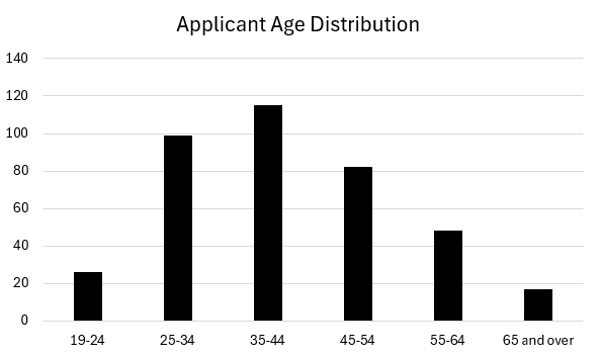
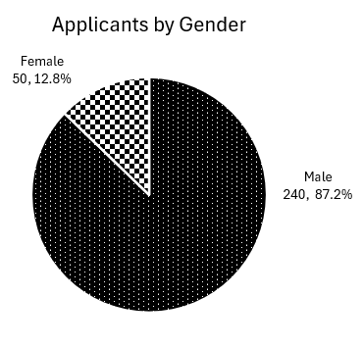
The sample was composed of 390 application essays. The average age of applicant was 41.7 (SD=12.2). Sixty-eight percent (68%) fell between the ages of 30 and 54. The youngest students were aged 19, while the oldest was 81.4 The sample was overwhelmingly male, with females comprising just 12.8% of the applicant pool (50 total).
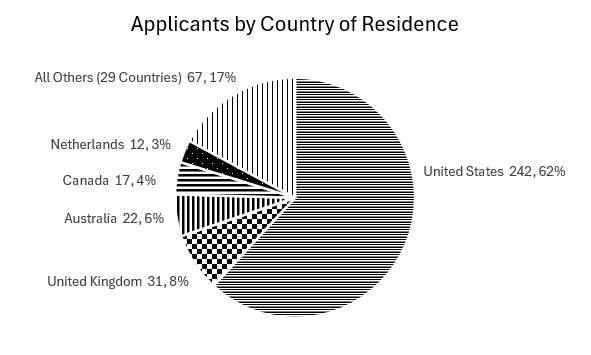
Applicants were resident in thirty-four (34) countries, with 62% coming from the United States, and single digit percentages from all others.5 Only 17% of applicants came from non-English speaking countries – not surprising since the College’s curriculum is English medium.
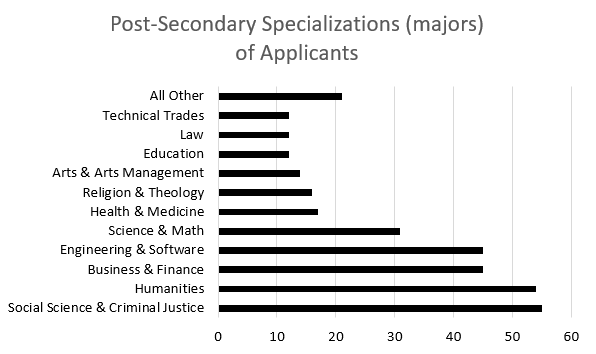
The College is not overly concerned with prior educational attainment, aside from applicants having adequate ability to complete the course. As a result, there was no consistent educational data to be collected. In general, the College’s applicant pool is more highly educated than the general population. Only 4.1% (16) reported only having completed high school or a high school equivalency. One student reported never having completed high school. Of those who did attend post-secondary education, 3.0% (12) received technical training for trades, while the vast majority proceeded on to college or university where their studies were widely varied. Only 5.0% (20) of applicants reported having majored in philosophy, while 4.1% (16) pursued religious studies.
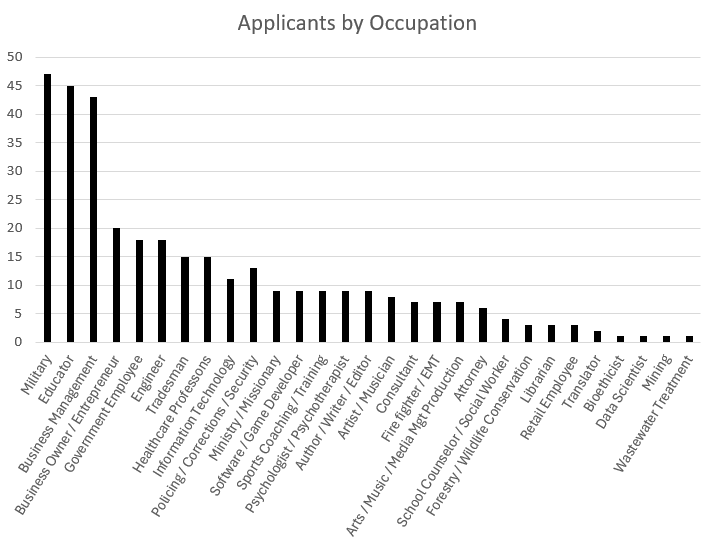
Applicants were coded for occupations indicated; in some cases, applicants were double or triple counted, in cases where they indicated substantial time engaged in different occupations. The three areas of greatest activity are military, education and business management, although virtually all areas of endeavor are represented among applicants.
Childhood Religious Exposure
In this section, we start with examining how the College applicants described their religious upbringing, their inherited religion.
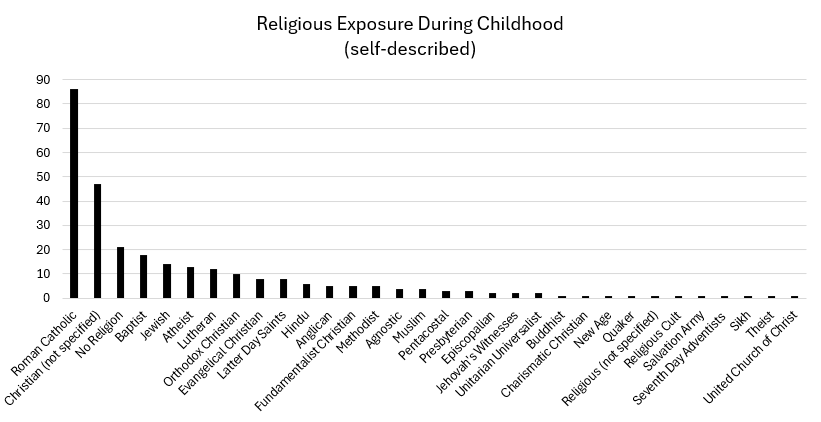
In the aggregate, more than three-quarters (76%) of this population came from a Christian household, although the degree of religiosity ranged from nominal to extremely fundamentalist. Thirteen percent (13%) of the study population were raised in a household which either practiced no religion or where at least one parent was atheist or agnostic.
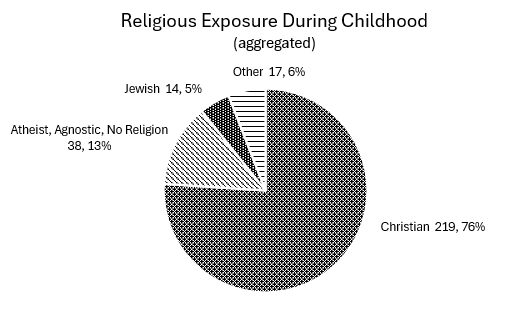
In all, thirty-two (32) separate childhood household belief systems were identified, including a broad range of Christian denominations, other major religions (Jewish, Hindu, Muslim, Buddhist, etc.), religious cults, and non-religious homes.
Religious Belief at Application
By the time they apply to the College, many applicants state that they have drifted far from their inherited religion, and their search for alternative forms of moral guidance or spirituality led them to Stoicism. Some describe this as rooted in the development of their reasoning capabilities in childhood or youth. Others relate a gradual drift away from the religion of their upbringing, in some cases combined with aggressive exploration of other religions or philosophical frameworks. More than a third of applicants (34.6%, 135) report having explicitly rejected the religion of their upbringing.
A deep erosion of traditional religious belief can be seen across the board. For example, while 86 applicants identified as having a Catholic upbringing (the largest single religious denomination), only 11 still considered themselves to be Catholic at the time of application. Of the 18 applicants who identified Baptist origins, only one (1) remained Baptist at the time of application. And so on down the list. Even Jews, a group with tightly intertwined conceptions of religion and ethnicity, saw their numbers drop from fourteen (14) raised Jewish to just three (3) who considered themselves to be religiously Jewish at the time of application.
Fifteen (15) childhood religious denominations or orientations completely vanished from the applicant pool. Among those that vanished were Anglicanism, Charismatic Christianity, Episcopalianism, Evangelical Christianity, Fundamentalist Christianity, Jehovah’s Witnesses, Latter Day Saints, Methodism, Pentecostalism, and Seventh Day Adventism, as well as Sikhism, Hinduism, and New Age religion.
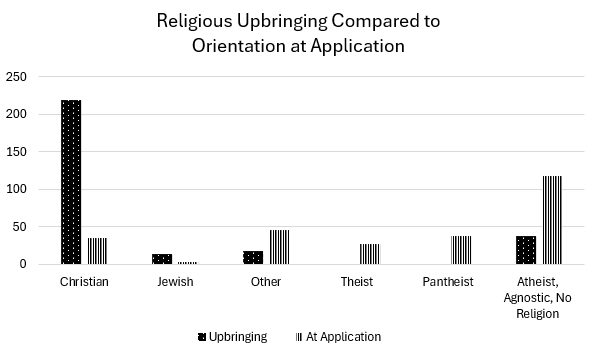
These findings align with broader demographic shifts identified by Pew Research, particularly the rise of the religiously unaffiliated, or “Nones.” According to Pew’s 2024 report, nearly 30% of U.S. adults now identify as atheist, agnostic, or “nothing in particular,” reflecting a significant decline in traditional religious affiliation. Many former believers cite doubts about religious teachings, dissatisfaction with organized religion, or a preference for personal spirituality over institutional faith. This trend is mirrored in our study, where a large portion of applicants to the College of Stoic Philosophers have moved away from their religious upbringing in search of a rational, structured, yet non-theistic framework for meaning and ethical living. Stoicism appears to serve as an appealing alternative, offering moral guidance and resilience without reliance on supernatural beliefs.6
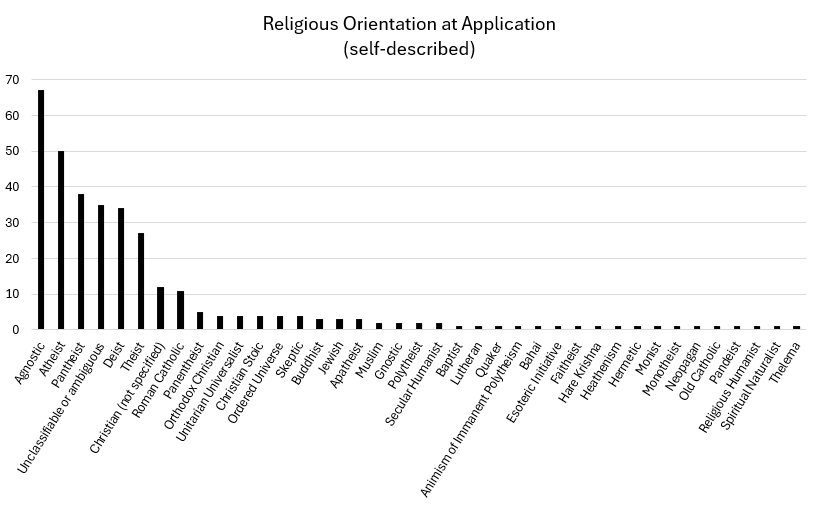
Perhaps even more striking are the multitude of distinctive ways that applicants describe their religious views at the time of application. A quick review of the list illustrates that this population has been deeply thinking about religion and conceptions of the Divine – generally probing far afield from their conventional religious upbringing. Thirty percent (30%, 117) reported having become either Atheist or Agnostic by the time of application. Another 25.4% (99) described themselves as either Pantheists (38), Deists (34), or Theists (27). A meager 8.7% (34) of applicants still described themselves as being of some Christian denomination.
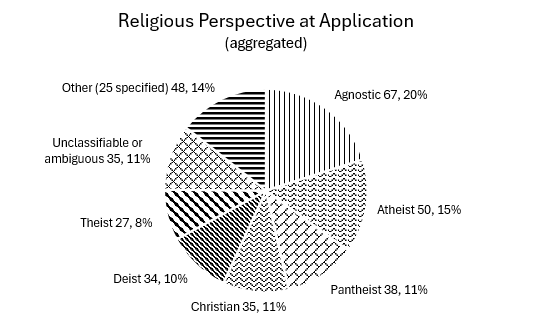
Applicants described their present religious or metaphysical beliefs in a multitude of ways – fifty-five (55) ways, to be exact. Interestingly, 11.4% (38) had also come to subscribe to Pantheism by the time of their application, an outlook that is in close alignment with traditional Stoic metaphysics and theology. Ten percent (10.4%, 35) of applicants were clearly rejecting something but were unable to articulate their present beliefs in a way that could be clearly interpreted, perhaps evidence of a search in progress.
The Journey to Stoic College Applicant
Thirty-four percent (34.3%, 134) of applicants reported having experienced periods of religious doubt. Nearly two-thirds (61.0%, 238) reported having engaged in religious or philosophical explorations prior to applying to the College.
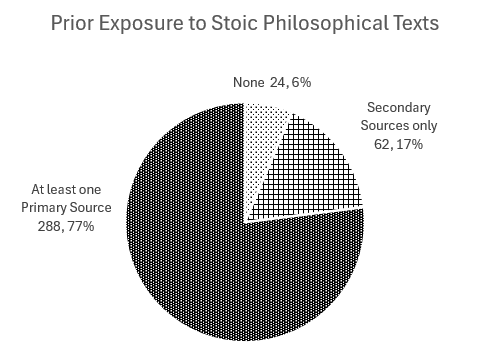
By the time someone applies to the College, they generally have more than a cursory familiarity with Stoic philosophy. Nearly all applicants (96.2%, 375) indicated that they had read or consumed books or other media related to Stoic philosophy in the past. Nearly eleven percent of applicants (10.8%, 42) explicitly referenced “Traditional Stoicism” in their essays, while 29% of applicants report that they have been influenced by the Stoicism on Fire podcast by Chris Fisher, which explicitly advocates on behalf of Traditional Stoicism.7 This clearly indicates a more advanced understanding among applicants of certain metaphysical and theological distinctions being made among contemporary Stoics. It is also notable that 77% (288) of applicants come to the college well prepared, having read at least one primary Stoic source from antiquity.8
In their Own Words
But how did they get to this point? In this section, we will draw heavily on the words of applicants themselves, who often best express their motivations and thinking. Their words have been lightly edited for readability. Only a very small sample is utilized here for purposes of illustration.
Breaking from Inherited Religion
For many, the break came in early or middle childhood, with an early questioning of religious belief, progressing from doubt about childhood concepts (i.e. the Tooth Fairy) to profound religious skepticism. Applicants recounted, for example, how they felt that childhood curiosity was stifled by religious dogma, how they felt confused over religious concepts and rejected religious instruction, and how religious exclusion in their childhood led to reflections on spirituality and the Cosmos.
In second grade my friend…told me that, ‘there is no Santa, your parents just dress up.’ When I asked my mom she said, “What do you think?” I got the message and went down the line…”Tooth Fairy? Easter Bunny? God?” The last one though she was firm did in fact exist.
As a child, I believed in Santa Claus until I saw my father putting candies inside my Christmas stockings. I was told not to question the bible and just believe in the word of God after I noticed and began asking questions about the overlaps and contradictions.
Religion had always confused me, even at a young age a concept like God didn’t make much sense to me. I especially remember questioning this as early as 5th grade. I had lost both of my grandparents on my father’s side of the family, as well as my mother’s side. I came home from Religion class one day and our family dog was gone – she went to “live on a farm.” That’s what my parents told me at least. I remember begging my parents to not make me go back to Religion classes. They didn’t. They kept their word and from that point on religion really was “dead” to me.
[W]hen I was 12…I wanted to enter the Scouts but was denied access for not being baptized. This form of exclusion made me reflect on what is Religion, Spirituality. I remember believing in a “Universe” not a God.
By the time I was 13, I was assertively Atheist. On top of that, I was convinced that all religion was essentially bullshit designed to control the moronic, ignorant, and self-obsessed masses.
For those departing their inherited religions later in life the complaints were not dissimilar. Comments ranged from forceful rejections of religion as “an opiate of the masses,” to the erosion of belief as a result of scientific and secular learning, a mismatch between religious teachings and observation, the failure of religious belief in the face of real-world suffering, religious dogmatism and even social ostracism.
Although baptized into the Catholic Church, I left organized religion in my teenage years; it never felt natural to me, and the more I learned about evolution, the less interested I was in the idea of a higher power.
I started to sense a misalignment of Christian theology with the nature of reality – my observations and experiences did not match what Christians were teaching.
I was a deeply religious Christian…In my mid-thirties, I was struck with a crippling depression. It left me broke, divorced, unemployed, and living with my parents. I became an atheist at that time as God’s biblical “promise” that he would give me peace and
Self-control was obviously false. I lost all my friends in my church for this decision. My social network vanished. I went to support groups and got serious about brain science with a determination to beat my depression.
I simply could not contend with the idea of such a God whose love was so conditional, whose desires so confusing. To make matters worse, I was actively discouraged to ask questions lest I sound too smart and too disrespectful.
[A]s I began to discover my sexuality, I experienced the true distancing of those very religious from me during this time. It was during this time [that] I was ostracized from the very thing I had built my life upon. Because I chose to be “different”. I was no longer part of the spiritual community and family I knew. Fortunately, this was the impetus that really compelled me to search for the meaning of truth and evolve my ideas of spirituality and religion.
I became disillusioned with the hypocrisy I saw. I no longer agreed with the radically conservative views [of my co-religionists]. My children and family were part of the ‘sinful’ population, being gay and transgender. The vitriol caused me and my wife to completely leave religion altogether.
Calvinism. That word ultimately spelled the doom of my youthful Christian faith. Somehow, my youth group had become infected with a long-running debate between Calvinist double-predestination and an Arminianism which allowed free will. This seemed to be a question of no small importance to me…What kind of God would create a man with the sole purpose of damning him? Surely that had to be false, and Arminianism correct. But I knew that, just because one alternative was more attractive, it was not thereby true. So, I agonized for months over this question, studying the Bible, talking with pastors, and reading other books. Even when I tried to put the question aside, it kept coming back: predestination or free will? Cruelty or kindness?
For me, faith always seemed the most difficult part of religion. I find myself requiring evidence through the scientific method, or at the very least personal experience. Like many who struggle with existential questions about our existence and purpose, I had studied several different spiritual paths, including Christianity, Islam, Buddhism, and the Western Mystery Traditions…I struggled with the idea that …they were the sole inheritors of Truth and everyone else was on the outside…I knew that if I were to adopt any of these worldviews, I would have to check my reason at the door. And this was just something I was not willing to do…It mattered to me that God, the creator of…the human ability to reason, was the kind of God that was first and foremost a reasonable being. But unfortunately, I didn’t find much reason in the arguments proposed by organized religion.
Feeling adrift
The departure from religion does not come without costs. Eleven percent (10.8%) of applicants reported feeling spiritually adrift. Many applicants recounted existential crises and the absence of a structured worldview post-religion. Some expressed dissatisfaction with both religion and secularism.
While a child and young adult, I adhered to this faith with abandon, but eventually I found it lacking and turned away from it in my late twenties…Left with no guiding principles, I embraced a universe of chance and chaos and lived my life on an ill-fated attempt to create my own meaning. Without the certainty that came from my religious upbringing I abandoned any sort of moral code outside of a generic ethic of being a “good person.” But this could only take one so far.
I had come to realize I had no place amongst the modern religious dogmatism of Christianity and secularism has left me unfulfilled. Neither of these things compelled me or spoke to me on a spiritual level.
[B]y the time I was sixteen I had rejected the religion of my parents and my community…I spent the next years seeking…something to fill that void. It was the beginning of my long career as a raging atheist who held the secret hope of being proved wrong.
[A]s I have drifted further and further from the theistic roots of my [Episcopal] upbringing…the need for some clear guidance on how best to live, some comprehensive ethical system, has grown correspondingly stronger.
Religious Experimentation
Sixty-one percent (61%, 238) of applicants to the College describe investigating and experimenting with other religious or philosophical traditions. These ranged from the conventional to the esoteric. Many applicants were deeply familiar with multiple religious, spiritual, and philosophical traditions, but ultimately expressed dissatisfaction with their various assumptions. According to one, “Spiritually, I have been on the hunt for probably half of my life.” Another claimed, “I have been searching all my life for answers to life’s questions.” Whether half or all of one’s life, the search has generally been a long and arduous one – often both eclectic and esoteric.
One applicant, for example, describes how he was raised to be an evangelical Christian, but as a teenager became an “unhappy agnostic, a bored humanist/UU, an uninspired deist, [who was] Buddhist curious.” Later, this same applicant “fell in love with the rationality of Maimonides, Chassidic Panentheism, the internal consistency of observant Judaism, and the intellectual and ethical depth of the tradition.” This person converted to Judaism and then subsequently de-converted because “the communities where I was comfortable and embraced felt spiritually unsatisfying, and the communities with the devoted and spiritual life I long for were mostly closed to someone of my background”. Of particular difficulty was the rejection of ethical relationships among consenting adults independent of “gender, bodily configuration, or number of people involved.” This may not be a typical journey, but it certainly reflects many of the streams of exploration and frustration seen among other applicants.
Like many who struggle with existential questions about our existence and purpose, I had studied several different spiritual paths, including Christianity, Islam, Buddhism, and the Western Mystery Traditions.
Sampling largely from among the great religious was one strain, but there has also been a considerable interest in esotericism and mystery religions.
I had a deep fascination with occult studies and Hermetics when I was younger because of the promise of supernatural powers. As I got older, the fascination turned into amusement.
I went through the Greek Pantheon, Roman Pantheon, Upanishads, etc. [Later], I…was initiated and Raised at the Most Worshipful [Masonic Lodge], and began my education into the rituals and mystery schools of antiquity…In this period, I become an ardent student of The Rosicrucian Order…after which I [studied the] Theosophical teachings of Madam Blavatsky from the Theosophical society…At the same time reading occult books…At the end of the day, the sum of this knowledge amounts to “NOTHING”. I have come full circle because I am no longer aware of where my beliefs/faith lie.
Affinities for Buddhism
Buddhism has been mentioned by many applicants as a formative subject of interest. In fact, Buddhist philosophy and practice was referenced as an area of prior exploration by 32% of applicants (125). Nearly 10% of applicants mentioned having habitually practiced Buddhist meditation in the past. Several had studied with notable Buddhist teachers and had lived in monasteries, in some cases for many years.
Interestingly, not one applicant reported being a practicing Buddhist at the time of application, although many continue the practice of meditation. Given the interest in Buddhism, it should come as no surprise that 12.4% (36) applicants also reported having an interest in Taoist philosophy. These were, by far, the most significant alternative areas of exploration prior to applicant’s entry to Stoicism. Many applicants explained their philosophical or religious difficulties with Buddhism, as well as affinities with Stoicism.
[Because] I had qualms about what I viewed as an omnipresent/omniscient monotheist deity, I studied Buddhism…While I admire its followers and its ideals of following “the Middle Way” and using meditation as a methodology of training your mind, it still seemed a little too lofty for me.
I have come to the conclusion that Buddhism overall is more religious than philosophical… People go through the motions the way they were taught and expect something in return; the whole time believing it will make things better.
I became increasingly unhappy…with the problem of cultural appropriation in the practices of this form of Zen Buddhism and what I saw as its general anti-intellectual bent for Western students. I was not Korean and found it increasingly challenging to work with this form of Zen.
I have always had a strong interest in Buddhism and Stoicism since I was in my teens. I feel like they have a lot in common. I guess the reasons I’m drawn more to Stoicism are firstly, it’s less esoteric…I also like the engagement with society that seems to be a natural part of Stoicism. It’s unlikely that I will become a forest monk, which often seems to be the stereotypical image of the wise Buddhist who has made it, completely disengaged from the modern world…[W]hile these two philosophies have things in common, there are also some drastic differences.
In my teen years I sought meaning in New Age and eastern belief systems, including Zen Buddhist meditations and Daoist practices. I gravitated to the lifestyle of a “religious maverick,” freely exploring and adopting any practices that I felt would 1) bring me closer to God, and 2) be directly helpful and applicable to my daily life.
Psychotherapy and 12-Step Programs
Cognitive Behavioral Therapy (CBT), Rational Emotive Behavior Therapy (REBT), Dialectical Behavior Therapy (DBT) and Logotherapy all have deep roots in Stoic philosophy. The Stoics, particularly Epictetus, Seneca, and Marcus Aurelius, emphasized the idea that our suffering comes not from external events but from our interpretations of them—an insight foundational to modern psychotherapy.
CBT, developed by Aaron Beck, follows the Stoic principle that changing our thoughts can change our emotions and behaviors. Epictetus famously stated, “People are disturbed not by things, but by their view of things.” CBT challenges cognitive distortions, much like Stoicism teaches detachment from irrational judgments. Albert Ellis’ REBT explicitly credits Stoicism, and the philosopher Epictetus specifically. REBT focuses on identifying and disputing irrational beliefs, much like how the Stoics sought to replace destructive emotions with reasoned responses. DBT, developed by Marsha Linehan, incorporates Stoic acceptance and emotional regulation. It teaches mindfulness and distress tolerance, reflecting Stoic practices of premeditatio malorum (anticipating adversity) and amor fati (embracing fate). Logotherapy, developed by Victor Frankl, also shares key principles with Stoicism, particularly in its focus on meaning, resilience, and the power of perception. All these therapies share Stoicism’s commitment to self-mastery, rational thought, and emotional resilience. By fostering reasoned thinking, they empower individuals to navigate life’s challenges with greater clarity and inner peace, demonstrating Stoicism’s enduring relevance in modern psychology.
Alcoholics Anonymous (AA) is a 12-Step self-help mutual aid approach developed by Bill Wilson and Bob Smith. Today, 12-Step programs address a wide range of addictions and compulsive behaviors. 12-Step programs share significant philosophical and practical similarities with Stoicism in the emphasis on self-awareness, acceptance of what is beyond one’s control, the cultivation of virtue through disciplined practice, and acceptance of a higher power or Providence. Many of the steps mirror the Stoic understanding that external events, including one’s past actions, are beyond personal control. What remains within one’s power is the ability to choose how to respond, aligning closely with Epictetus’ Dichotomy of Control. 12-Step programs, like Stoicism, stress the importance of self-examination. Step 4, which involves making a “fearless moral inventory,” parallels the Stoic practice of daily self-reflection, as recommended by Marcus Aurelius and Seneca. Additionally, the emphasis on amends in Steps 8 and 9 aligns with Stoic ethics, which advocate for just action and reconciliation. Furthermore, the cultivation of humility, a cornerstone of both traditions, encourages individuals to accept their flaws while striving toward moral improvement. Step-12, a commitment to service and mentorship, resonates with Stoicism’s emphasis on social duty and the interconnectedness of human beings. Ultimately, both the 12-Steps and Stoicism function as practical, lived philosophies aimed at fostering resilience, wisdom, and inner peace. They provide structured paths to self-transformation through acceptance, discipline, and ethical living.
Given the interconnections between Stoicism and both modern psychotherapeutic techniques and 12-Step programs, it is not surprising that these might serve as a gateway to Stoic philosophy for some persons. Ten percent (10.0%, 39) of applicants stated that Psychotherapy or Grief Counseling was their entry point to Stoicism, either as a patient or as a practitioner.
Approximately the same percentage indicated having previously read or consumed media related to psychotherapy, with most referencing CBT, REBT, DBT or Logotherapy. Nearly 3% (2.8%, 11) indicated their entry point to Stoicism as being a 12-Step program.
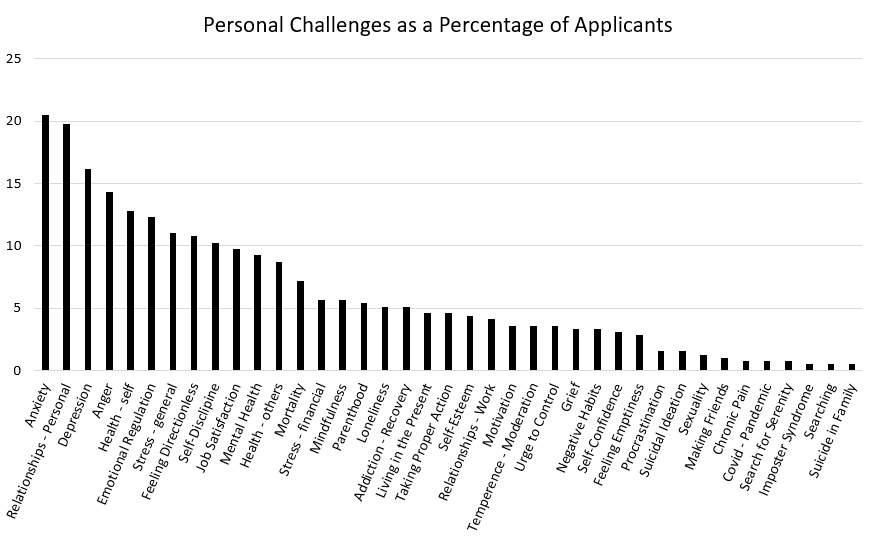
Some applicants were experienced psychotherapists, the vast majority were not. Applicants were asked to describe their personal challenges. Many applicants reported transformative experiences with psychotherapy and how they made the connection to Stoicism. Some discussed how psychotherapy was an incomplete solution which was enhanced through the addition, or substitution, of Stoicism.
It’s only within the past few years or so that I’ve been exposed to Stoic philosophy, primarily through my work as a mental health therapist. Having integrated cognitive behavioral therapy, solution focused therapy, and similar theoretical modalities into my work, I’ve learned that many counseling theories attribute aspects of their collective wisdom to Stoic and Socratic philosophy. Through Cognitive Behavioral Therapy and Solution-focused Therapy, I’ve been exposed to excerpts from Aurelius’s Meditations and Epictetus’ Enchiridion and Discourses. Through my readings and initial research, I was later exposed to what seemed to be an explosion in Stoic principles and values within the current cultural zeitgeist, which has led me to this course….
I…went to a cognitive behavioral therapist a few times and found that that therapy is explicitly influenced by Stoicism.
I struggled to have any spiritual, moral, or ethical direction in my personal life; this
led to depression and anger, both of which got to the point where I could no longer control or suppress my feelings, and I ended up seeking professional help. Through therapeutic sessions and my own research, I ended up learning about Stoicism and applied its principles to my life.
I was picking unnecessary fights with coworkers I disagreed with. I felt like all of my projects were stalling out. I did not seem to have the skills to cope with anxiety and stress. I was reverting to old habits and giving into the passions of anger and overindulgence to get through the day. Therapy wasn’t really working. Antidepressants weren’t really working. I knew my mindset needed an adjustment or I was going to give myself a heart attack. Around the time that I was having this realization, someone recommended [Stoicism].
Some applicants came upon Stoicism during recovery through 12-Step Programs. These programs, however, often require belief in higher power, which is a struggle for many, particularly those who have abandoned religion or who have lost faith. Applicants recount how Stoicism became a substitute for or complement to 12-Step Programs as a result of its explicitly being a rational form of spirituality.
I eventually found my way into the rooms of Alcoholics Anonymous. There I found another approach to living that I’ve been struggling to adhere to for coming on two years. The problem is that the 12-Steps of Alcoholics Anonymous requires belief in a power greater than me. As an atheistic materialist, I’ve found it difficult to make progress beyond Step Two which states that we “came to believe that a power greater than ourselves could restore us to sanity.” I’ve recently begun listening again to the podcast Stoicism on Fire by Chris Fisher in an attempt to find a rational form of spirituality and belief in a divinity which I find intellectually honest. And that is what is leading me to apply to the Stoic Essential Studies program at the College of Stoic Philosophers.
I had become suicidal and terrified. I desperately needed a solution, and AA had lost its lustre. I had stopped learning after 30 years… [I happened upon a Stoic book which became] a life changing experience…I found the connection to Stoic philosophy, and it resonated in my core. All the teachings in AA I had now found in Stoicism. A counsellor once said to me “go to the source” and I was baffled. Now I understand. The most power one gets is to be plugged into the source, not the miles of extension cord which weakens the message. I have found a power that charges me as religious platforms never had.
[Because of Alcoholics Anonymous]…and the tools that it gave me…sobriety is now a mainstay in my life… I was…trying to define my higher power, when I noticed that the AA program…had a lot in common with Buddhism. I grasped onto the teachings of [many Buddhist teachers], and finally came across Noah Levine, and Against The Stream, the Buddhist approach to recovery. I latched onto it with an optimistic fervor. I started meditating on a daily basis, which I still do to this day. Buddhism seemed to be what I was looking for, with an easy, non-dogmatic approach to dealing with life, but I was having a hard time wrestling with some of the concepts of no-self, small-mind, emptiness, etc. Then one day…I came across William Irvine’s [work on Stoicism] “A Guide To The Good Life”… I was enthralled.
One day, a Catholic man I knew in the rooms of AA… someone I respected and admired… a man whom I considered to be genuine and authentic in whom he presented himself to be… and who had been sober for years… gave me a sheet of paper about the Stoic philosopher Epictetus…The impact of that introduction to Stoicism did not take hold of me immediately, but it definitely stayed with me. It parked itself in the back of my mind somewhere. [Then] the seed which he had planted was taking root and steadily growing within me.
Oops! I found Stoicism!
We mustn’t forget that for many, the doorway to Stoicism was not the result of a purposeful or conscious quest or existential crisis, it resulted from some other chance encounter, whether that be the result of browsing a bookstore, taking an online quiz, or even mistaken assumptions. One applicant recounted how he was given a gift certificate to a bookstore, but since he wasn’t a reader he just purchased the thinnest book he could find for the value of the certificate – that book turned out to be Epictetus’ Enchiridion, and he was hooked. Others recounted similar chance encounters.
I chanced upon the collection of Seneca’s letters in a bookshop…and decided to buy it. As I write this, the memory of sitting in a park and reading the first two or three letters has returned to me. As I read on, I remember being struck not by any seemingly perfect virtue in Seneca (unlike most depictions of the Buddha), but rather in his humanity and humility in expressing his foibles in his quest for wisdom and virtue. Here seemed to me to be a philosophy that was practicable. I decided that it would be worth delving deeper into Stoicism.
I stumbled on Stoicism by accident. I don’t know exactly how anymore but I acquired a copy of the Meditations of Marcus Aurelius. I read through It in a couple of days, and it was love at first sight.
My initial exposure to Stoicism happened serendipitously. About five years ago, I started engaging in a daily meditation practice. Around that time, I stumbled across the book, Meditations by Marcus Aurelius. I mistakenly thought it was a text on meditation techniques, practiced by Greco-Romans. Once I dove into his writings, I was fascinated by his reflections and insights of daily life. Yet, many of the passages in Meditations are simple, straightforward, and practical for the layman, without any previous knowledge of Stoic thought.
I found Stoicism by accident by taking a “What Philosophy School are You?” test on Facebook. After I took the test, it replied with this answer: “You are a Stoic.” As I read about Stoicism, I came across “Stoic Month” the very week it had begun. I enrolled, went through the lessons and found that I really WAS a Stoic. The glib Facebook test was right. But the ideas were not new to me at all. I pretty much came to the same conclusions Seneca and Epictetus did long before I ever took the course.
Concluding Thoughts
This study provides a first-of-its-kind analysis of the formative experiences of individuals who choose to undertake the formal study of Stoic philosophy, offering a deeper understanding of the factors driving Stoicism’s contemporary resurgence. Drawing on demographic data, autobiographical essays, and thematic analysis, we get a glimpse of the key pathways that lead individuals to Stoicism, particularly through prior engagement with religion, psychotherapy and addiction recovery programs, and philosophical exploration.
A striking pattern emerges: most applicants to the College of Stoic Philosophers have distanced themselves from their childhood faiths, often due to intellectual skepticism, existential crises, or disillusionment with organized religion. Others arrive at Stoicism through a history of engagement with Buddhism, mindfulness practices, or modern psychotherapeutic approaches such as Cognitive Behavioral Therapy and Rational Emotive Behavior Therapy—both of which share foundational principles with Stoicism. Some applicants, particularly those involved in 12-Step programs, find in Stoicism a rational form of spirituality that aligns with their need for structured self-improvement without requiring theological commitment. Others find it seemingly accidentally but discover that it meets an unmet need.
While this study does not claim to provide a definitive answer, it does illuminate how Stoicism appeals to those seeking a practical, rational, and virtue-oriented framework for a spiritual life. As interest in Stoicism continues to grow, further research may explore how its principles are adapted across different cultural and philosophical contexts, as well as its long-term impact on practitioners’ lives. In a world increasingly defined by rapid change and instability, Stoicism offers not just an intellectual tradition but a lived philosophy—one that provides clarity, resilience, moral direction, along with spirituality.
A Note on Future Directions
This study represents just an initial and strictly descriptive exploration of the data, but it raises many additional questions. What explains why women comprise such a small percentage of all College applicants? Is the profile of women similar or different from that of men? What characteristics – demographic or experiential – are associated with successful completion of (or failure to complete) the course of study? Can we identify specific determinants of success? These and many other questions can be explored using inferential statistics with this same dataset.
Beyond the scope of this data are other questions, particularly related to the religious or spiritual trajectory of the College’s students. We now know something about the journey prior to application to the College – but what can we learn about how their perspectives evolved following their successful completion of the curriculum? Was Stoic philosophy a station along the journey, or did it become a habituated way of life – the terminus, so to speak? These questions will have to wait for further research into this unique data source that is the College of Stoic Philosophers.
Footnotes:
1 Google Trends. https://trends.google.com/trends/. For information on how Google Trends uses and interprets data, see https://support.google.com/trends/answer/4365533?hl=en. Data utilized for this chart were retrieved on February 14, 2025.
2 Shayla Love, “The Revival of Stoicism,” Vice News, June 29, 2021. Accessed on November 22, 2024, https://www.vice.com/en/article/the-revival-of-stoicism/
3 As of November 22, 2024
4 Although the College has a preparatory program for teens age 13 to 18, this study was confined to adult students applying to the Stoic Essential Studies course.
5 The College does not have data on nationality, only country of residence. Nonetheless, it is reasonable to assume that residency and nationality correspond closely.
6 Pew Research Center. Accessed February 21, 2025. https://www.pewresearch.org/religion/2024/01/24/religious-nones-in-america-who-they-are-and-what-they-believe/
7 This includes only applicants since 2018, the year Stoicism on Fire first appeared. https://podcasts.apple.com/us/podcast/stoicism-on-fire/id1368482721
8 For purposes of this research, primary sources were any of the following canonical works: Marcus Aurelius’ Meditations, Seneca, Letters from a Stoic, or Epictetus’ Enchiridion and Discourses.