
Look within. Within is the fountain of good, and it will ever bubble up, if you will ever dig.
Marcus Aurelius, Med. VII, 59
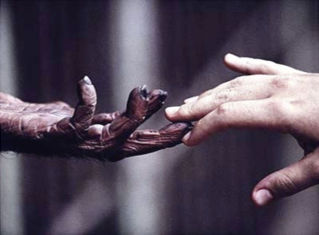
This article is a review of the book The Bonobo and the Atheist by Frans de Waal. I read it because I love my primate relatives, and I was promised by the blurb that it would give me a better insight into the origins of human moral behaviour. I wasn’t disappointed: reading the book was a pleasure. Not only because de Waal is an engaging storyteller, cramming his book full of primate-related anecdotes, but also because it provided this modern Stoic with state-of-the-art evidence for one of the most important aspects of our ancient philosophy.
The foundation for Stoic ethics has its basis in oikeiosis. According to Hierocles, all animals find value in themselves and their own well-being, and a concern for others is a logical extension of this natural tendency for self-preservation. We Stoics see our acts towards the well-being of others as a duty, seeing that they derive from principles of Nature. The Stoic idea of caring for others is illustrated by Hierocles with a model of social duty consisting of concentric circles. Humans can extend the natural care they feel for themselves to others in their direct vicinity like family, and then further outwards to the rest of humanity in ever widening circles of concern, eventually comprising the whole of the human race.
This has always seemed to me to be a very level-headed description of a group animal: the need for self-preservation as the basis of group cohesion. It is an idea that I always found so convincing that I thought it should easily survive the scrutiny of modern research. But I didn’t know for sure, of course. So I was interested to know if I could find evidence in de Waal’s book, to prove or disprove this Stoic principle.
Moral apes
Frans de Waal is a Dutch primatologist with Emory University, who has done an enormous amount of research (and has written a great number of books) on the social behaviors of primate species. He is perhaps most famous for his research on those little love-making chimp-like primates, the bonobos.
The aim of ‘The Bonobo and the Atheist’ is to convince us that our own morality is an intrinsic part of human nature, that it is not just a thin veneer of appropriate behaviour overlaid on an basically barbaric species. De Waal sets out to do this by showing that our cousins the chimpanzees and bonobos behave according to rules of morality, which leads to the inevitable conclusion that, as we share the same ancestors, morality must have been part of the human species for much longer than people originally thought. In proving this point, de Waal also shows that morality is not the invention of religions (or indeed philosophy…), but that it actually predates religions and current civilizations by about 100.000 years.
De Waal has at his disposal a seemingly bottomless well of first-hand knowledge and anecdotes about primates, and he uses these, as well as the results of years of research, to flesh out his theory with infectious enthusiasm. Our nearest relatives are fascinating if only because they look so much like us. For a long time, however, it was absolutely forbidden to attribute any psychological characteristics to any kind of animals, even apes, that were thought to be the sole property of humans. Nowadays, scientists know better, and there is a lively interest in what is after all a great source of potential knowledge about the ancestry of our own behaviours. De Waal says he doesn’t think that studying bonobos can show us what is right and wrong per se, but knowledge of their nature helps to understand our nature, how and why we began to care about each other, and why we strive to live moral lives.
De Waal explains that the all-important basis for morality is a feeling of empathy, the concern for others. This feeling leads to actions to ensure others’ well-being. Chimpanzees and other primates are shown by the Waal as creatures who can often be seen comforting each other, licking each other’s wounds, taking care of each other’s young, and even defending each other in case of what seems to be deemed by them as ‘inappropriate violence’ by a member of the group (rules about primate etiquette are upheld, and breaches of same rules are punished with much screaming and chasing of the culprit). Reciprocity is also central in chimp societies. For instance, de Waal reports he has observed thousands of instances of chimpanzees exchanging food with each other.
Altruism: taking morality one step further
Licking someone’s wounds may get you a cuddle in return. Exchanging food has its obvious rewards. But de Waal shows how chimpanzees often choose behaviour that is beneficial to others even when there is no reward in it for themselves. In one series of tests, pairs of chimpanzees were put in separate spaces, where one chimp was rewarded if she offered the researchers a red or a green tube. She herself was rewarded regardless, but only the green tubes caused her chimpanzee partner to get a snack as well. More often than not, the chimps would choose a green tube, thus ensuring the other chimp of a treat. Attempts at coercion and threatening from the chimp-partner immediately put an end to such pro-social behaviour… Human children score about the same in these tests as chimpanzees by the way (78% pro-social behaviour).
Why would chimpanzees show such behaviour? What do they have to gain from it? After all, they have no Bible promising rewards in the next life, or philosophy books telling them virtue is the way to happiness. The reason given by de Waal is that group animals intuitively work towards group cohesion as a means of survival. The long-popular but for group animals inappropriate notion of ‘survival of the fittest’ has some time ago been replaced by the idea of ‘survival of the co-operative’.
Morality and the need for restraint
Besides empathy, the beginnings of another important virtue can also be found in our primate roots: the virtue of restraint. Examples of the presence of this skill in our respective species is that in tests, both human children and other primates are able to postpone their need for satisfaction of desire for about 18 minutes (get one treat now, or two treats if you can wait).
We apes need this skill because primate societies are based on social hierarchy, with a complex system of rules about what is forbidden. Mindlessly giving in to desire may lead to very dire consequences, which is something young apes learn as they grow up and get punished for being naughty. They quickly learn it’s better to be safe than sorry. And so all primates have a social life in which both emotions as well as control of those emotions play a central role. This ability to control impulses is not just rudimentary in our relatives: tests and observations with chimps show that there is a huge gap between impulse and action. All this because we need to know our place in the hierarchy. Respect for moral laws is indicative of a species that strives to maintain a good relationship with its leaders.
And thus the Stoic sees himself mirrored in his cousins: both in deeply moral behaviour towards others, and in our distancing ourselves from our emotions in order to consider which action is the right one.
The limitations of natural empathy
So what can we do with this knowledge? De Waal leaves no room for doubt that empathy is natural in primates such as human beings, and that it is a characteristic of all group animals, and certainly primates, to behave according to moral rules based on empathy and restraint.
It certainly doesn’t mean that we primates are all basically good guys, and that all our human Stoic practice is superfluous. This quickly becomes clear from de Waals description of violence in great apes. The rules of morality and their constant re-enforcement and practice are necessary exactly because we primates are capable of both desirable and undesirable behaviour. Especially humans and chimpanzees are capable of great violence amongst themselves, for instance. Even bonobos, whose preferred mode of settling any kind of conflict is to have extremely casual sex (de Waal confirms this throughout the book), have their ‘evil’ moments where one of them occasionally goes off the rails, and needs to be severely reprimanded. Empathy, in other words, is needed when restraint is absent, and ensures that primates police their groups to keep them together.
Still, we might conclude from the above that emotions, feelings of empathy, are enough for us humans to act virtuously. Unfortunately, however, this is where it gets complicated for our species.
First of all, even on their own, our natural good qualities aren’t perfect. Look at the limits of empathy for example. Empathy has now been shown as the basis for morality, and is seen as almost holy by many humans, a source of pure good. But beware: empathy is not impartial. De Waal recounts a Swiss experiment with rather shocking but perhaps not wholly surprising results. When these Swiss researchers put groups of football supporters in a test environment and inflicted pain on some of them, the supporters only reacted with pity and horror to pain inflicted on one of their own fan club…. and from their brain activity it was shown that they actually enjoyed the pain of their rivals! See here the limits of this basis of our natural goodness – behold the gigantic room for improvement in a world where very large groups of humans are forced to live together.
The difference between us and them
Secondly, there is a huge difference between humans and all other primates. A human society doesn’t only consist of larger numbers of individuals containing many sub-groups; its workings are far more complex than any other primate’s, and de Waal explains that we are the only ape that needs Reason to navigate through its intricacies.
The complexity of human life requires a level of morality which can be found in our cousins, but only sporadically. This level can be termed ‘justice for all’. The virtue of justice is shown by de Waal to have a long history: humanity shares with other apes a universal predilection for equality which dates back to our shared ancestors. This sense of justice can be divided into two types. There is the basic type: justice of the first order (defending our individual rights to fairness). All apes, and human children as young as a 1-year old, show a strong preference for this type of justice. Fairness tests with apes show that our human sense of justice of the first order is rooted in basic emotions, and is not the product of our much-praised rationality. But then there is justice of the second order, which is a preference for fairness in general, not affecting the individual.
Although other primates are shown in tests to be sensitive to the second order of morality, ‘justice for all’, it is found most prominently in humans. In humans, enlightened self-interest is the motivator behind care for the community. Moral transgressions are bad for everyone, even if they do not affect us personally. Prestige and the formation and preservation of our reputation are important reasons why people act in the best interest of their group. Chimpanzees may show some behaviour indicating that reputation and care for the community are of some concern for them, but humans go much further than that. We have evolved to a complexity where our skills of estimating how our actions will influence general interest, and discussing among ourselves (using language) which rules and sanctions will be used, are essential for our survival. We need to be good at abstract thinking for this.
In short, de Waal argues that the kind of morality which keeps a human society ticking is based on Reason. De Waal says literally that the further we broaden our morality, and the more we apply it to the world in general, the more we need to rely on our intellect. This is because biology has hardly prepared us for the rights and duties on the scale of the modern world. In short, we have evolved as group animals, not citizens of the cosmos: that is a philosophical concept. De Waal consoles us however, by saying that we humans have a long history of building new edifices on old foundations.
So there we have it: we may be group animals, and we may have a biological emotional basis for behaving morally in common with our next of kin, but human morality is so complex that it simply cannot work without Reason.
Morality and happiness
So far, the Stoic has much to be pleased about from reading de Waal’s book. The principle of oikeiosis is shown to be an intrinsic part of our animal nature, and virtue is quite satisfyingly given central stage in our lives: practicing moral virtue is what ensures our very survival as primates.
I was surprised therefore by one seemingly chance remark in de Waal’s book, which I want to go into because of its implications for Stoic philosophy. For us Stoics, virtue is the basis for happiness or more precisely, eudaimonia. De Waal states (without hinting at any sort of proof) that the idea of eudaimonia originating from a life lived morally is not based on empirical evidence whatsoever. He says that it is nothing more than an opinion.
First of all, this to me seems counter-intuitive. Elsewhere in the book, de Waal says that morality based purely on rationality is unlikely to be successful, because individuals need to be motivated by strong moral feelings. What else is eudaimonia, I wonder, but a strong feeling caused by the knowledge of having acted in accordance with our deepest nature? Isn’t it perfectly logical that we should feel good if we find that we have been the best we can be?
This is not the only time de Waal gives an opinion without offering any evidence for its verification, but here it seems to me that he is unaware of the growing body of research in this particular area. It goes too far to go into it in much detail here, but for the interested reader, ‘The Virtuous Cycle’ by researchers Kesebir and Diener (ref. below) offers an excellent overview of recent research into eudaimonia. According to them, “recent decades have witnessed substantial progress in identifying the concomitants and causes of happiness,” and they conclude: “Our review points to a clear association between happiness and virtue.” They point to a large body of research done by many others, all of which not only suggest that virtue leads to happiness, but that it becomes what they call ‘a virtuous cycle’, where the resulting happiness leads to more virtuous behaviour, leading to more happiness etc.
So contrary to what de Waal supposes, and in accordance with our Stoic convictions, virtuous behaviour does seem to be essential for a life of happiness.
Conclusion
Hundreds of years of history, that’s a lot of water under the bridge. Some of the ancient ideas of cosmology may have fallen by the wayside, but I continue to be amazed by how Stoicism can be understood and lived by a modern individual and remain uncontradicted in its essential points.
De Waal’s book has convinced me that the Stoic ideas of oikeiosis, of virtue being central in this, and of Reason being essential to rule these principles, are even today still an excellent foundation for our philosophy for living. They touch upon the essence of what makes us human animals, on how we function, and call forth the best in us.
I do recommend the book for reading. It isn’t just for primate-fans. In my article I have concentrated on the natural basis of morality, but when you read the whole book it seems to fall into three subjects. Firstly, a bit of a rant against fundamentalist atheism, which I must say I secretly found refreshing after having been subjected to too many atheist rants. Secondly, an attempt at art criticism using art as an illustration for human morality, which as an artist and art lover I found rather disappointing. Thirdly, the main body of the book: a convincing argument in favour of de Waal’s statement that morality is as old as we primates are.
De Waal’s book is not the most rigidly scientific perhaps, because of its meandering style and off-topic excursions. But having said that, as a collection of wonderful anecdotes about morality in all sorts of animals besides humans, and ideas about the beginning of morality, it’s a very worthwhile read.
Most importantly for me, its conclusions are consistent with the ancient notion of self-preservation being at the basis of how we survive, this sense being extended to the care of others, of virtue being the means of how to do this, and of Reason being the way to implement it. Religious people, believing in the supernatural, often have great problems with the notion of morality not being handed down in the Bible. For a Stoic, the idea that morality predates philosophy and current civilizations by thousands of years is the only logical conclusion: after all, what else could our morality be than – part of Nature?
Kesebir, Pelin (University of Colorado at Colorado Springs) and Diener, Ed (University of Illinois at Urbana-Champaign): A Virtuous Cycle: The Relationship Between Happiness and Virtue Published in: http://www.academia.edu/
Waal, Frans de The Bonobo and the Atheist: In Search of Humanism among the Primates New York: W. W. Norton, 2013. (NB: I used the Dutch translation because I was reading it with a Dutch reading group. The Dutch title is: ‘De Bonobo en de tien geboden’).