Tuesday, 25 August 2015 : Tokyo. The first time I flew to Tokyo it was in early September of 1980. I flew in from Rome, and I was alone. I had a small, red backpack with a single change of clothes and a few toiletries. Packing took about 5 minutes for a journey that was going to last six months or more. Today, at 70-years-of-age, half of my lifetime later, packing and preparation filled several large suitcases and took hours when including the careful decisions and inspection of climbing clothes and equipment. This time I was with my wife, Amielle, and we were only staying in Japan 11 days. Our first stop was an Airbnb in Tokyo before going on to Fujiyoshida as our base for climbing Mount Fuji.
* *
“Libertarians are morally bankrupt,” he said. The young man saying this was our Airbnb host in Tokyo. I will abbreviate his name by the initials, DR, to protect his privacy. So, DR and I were talking about political philosophy while sitting and drinking green tea in his kitchen, which was surprisingly roomy for a Tokyo apartment. The young man, maybe 28 or 29, a bachelor, was an English teacher and on the administration staff of his school. He was from Louisiana, USA, a very Deep South state in both geography and conservative philosophy. DR was talking about his own conversion from being a hardcore Libertarian to an entirely different point of view. It happened in Japan.
In Japan, equality is more important than freedom, and the group is more important than the individual. You would expect a Louisiana Libertarian to find such a country virtually uninhabitable; but, in fact, DR had lived and worked in Tokyo for three years and had vowed he would never return to America again. He would visit his family, as he did a couple of times a year, but that was all. DR first became a Libertarian in college, he said, and he was still registered as a Libertarian back home, but he was not that kind of person anymore, and he repeated several times, “Libertarians are morally bankrupt.”
Was he right? Are Libertarians morally bankrupt? DR didn’t have much more to say about the subject. He didn’t offer any proofs. He wasn’t a philosopher. His idea of moral bankruptcy focused on what he perceived as a callous indifference to the welfare of others. Indifference. That word rang a bell. We changed the subject because I could see he didn’t really like talking about it and preferred talking about his travels around Asia. I wasn’t especially interested in his travels, but I could see it made him uncomfortable to say any more about Libertarians. I let it go.
*
27-28 August 2015: Fujiyoshida. After yesterday’s scramble to get here to Fujiyoshida—several subway changes in crossing the city, buying the train tickets, then taking two hours to go about 60 miles—Amielle and I were both knackered when we checked into Michael’s Fuji Hostel. Even so, we had enough strength left to walk the length of the town to the Shinto shrine, Kitaguchi Hongu Fuji Sengen Jinja. We wanted to see this shrine because it was the Yoshida Trail portal at the base of Mount Fuji. Also, we had been told at the hostel that they were having their annual Fire Festival there, an all day event, and that was another reason to go.
It appeared as if all of the citizens of Fujiyoshida were there. The Fire Festival was quite extraordinary in itself, but this is really not a travel book, so I’ll not mention any details, except to say that this was the most beautiful Shinto shrine I had ever seen in my travels and residences in Japan. After the festival and a good night’s sleep back at the hostel, we mostly loafed, ate, packed our backpacks, did some laundry, and got everything in readiness for the climb the next morning. A quiet day. Long silences.
Saturday, 29 August 2015: 4:00 am: I woke up and mentally went through my collected fragments of Heraclitus while waiting for it to get lighter. By 4:30 am, I was up writing in my journal, because something occurred to me that I wanted to remember. That is, IMO, the key to Japanese culture, the uniqueness of it, may be their insistence upon the value of form balanced with content. In Western cultures, especially the US, content is far greater in importance. In Japan, perhaps the best example of their appreciation for form is in the tea ceremony: beauty in the simplest action. This reverence for aesthetic perfection pervades all of their culture. Amielle and I were at the Yoshida Trail portal by first light.
3:30 pm: Mount Fuji Sixth Station: resting on my futon at the mountain hut, Seikanso. A little over half way to the summit. Got here about 2:30 pm – average time considering Amielle and I made a number of stops to take photos of both natural scenes and Japanese calligraphy carved into ancient, mossy stones along the way. This was the Pilgrim Trail, which had only about 10% of the climbers you would see above the Fifth Station. Most Mount Fuji climbers now begin the climb at Fifth Station, half way to the top, which was recently connected by a highway and many buses. Most climbers don’t really see the beauty of Fuji. They begin at the tree line, which is unfortunate. The lower half is more beautiful than you can imagine. It was misty, with an occasional light sprinkle, and the world was many shades of green, cool and quiet. We were alone most of the way.
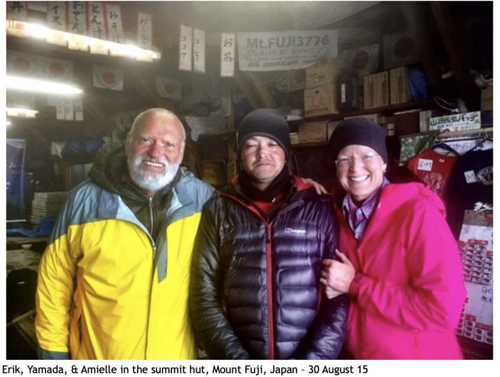
Sunday, 30 August 2015: Mount Fuji Summit: It was hard. Time and again it was hard, but the last 200 meters were the hardest: climbing with hands and feet over lava rock in pouring rain and sleet driven by fiercely gusting winds. Soaked to the bone, wet and freezing cold for so long I no longer thought about it. The last 200 meters, so steep, pulling with my arms, pushing with my feet, I could no longer feel my hands and could not close them to make a fist, but they were still there pulling me up through the blinding, freezing rain, blinking wildly to see the next handhold through the gushing waterfalls streaming down in every direction, pulling myself up against the wind that was both freezing and pushing hard against me. Looking for handholds, looking for toeholds, and yelling, grunting, groaning, commanding, angrily demanding this leg, then that one to lift and push once more: Push! Pull up! Push! Pull! Then standing upright and feebly walking the last steps. Sliding open the wooden door to the wooden summit hut where it was dry, cold and dry, no howling wind or freezing rain. Other climbers. A wooden bench to sit on. Then the shaking.
We still had 3½ or four more hours to go down the mountain, but first I had to rest and get dry. There was no heat in the summit hut, freezing, and I had no dry clothes to put on, and I couldn’t have taken off my wet clothes and put on dry ones even if I did, because I was shaking too hard all over my body to function. My head, my hands, my arms and feet and legs and torso and stomach. Amielle was rubbing my arms and legs. The other climbers, maybe eight or ten of them, Japanese, nearly all young men, looking away, talking, laughing, congratulating themselves, each other. They are happy. I’m shaking and shaking, and there is nothing else I can do. Nothing else to think about.
One Japanese man, maybe he was an attendant at the hut, I don’t know his name, maybe it was Yamada, came up to me with a warm dry, synthetic pile, olive drab coat with a hood – old, used, tattered at the ends of the cuffs – and he orders me, first in Japanese, then in English, to “put on coat!” Amielle helps me take off my wet shirts and Yamada helps me put on and zip up the coat. I’m still shaking. Amielle buys two small, plastic bowls of lukewarm fermented soybean and seaweed soup (miso shiru) and two small Styrofoam cups of weak and tepid green tea. $26.00 USD. Even in my condition I notice the cost and the quality. I can’t hold either the bowl of soup or cup of tea, so Amielle helps me, keeps urging me to eat, drink; but, it’s nasty, tastes oily, awful, and I want to vomit.
Earlier, we had been warned three separate times by different groups of climbers descending the mountain that we couldn’t go on. Conditions at the top were too treacherous and we would be turned back between the 8th and 9th Stations. Three times before we got to 8th Station we were told why we couldn’t continue, and three times we thanked them for their kindness and went on. From the time we started before dawn, there was nowhere to stop and rest, only lava rock, nowhere to get out of the cold and icy rain. Nature was fierce and soaking wet.
Personally, although I didn’t say so, deep down I was glad when I heard we had to turn back, and I kept looking for someone, some official to forbid us to go on. By the time we had passed the 7th station, I was already too cold and wet and tired, exhausted, and there were at least two or three more hours to go. I wanted it to be over. I wanted to turn back, but no one told us we had to stop, so we kept going up and up through the storm, the hard, freezing rain coming straight down, then sideways, then horizontally full in our faces, stinging like a thousand needles, then the wind blowing so hard we couldn’t move, just hunker down until the blast subsided, then inching forward. I was soaked to the bone. My outer light jacket was water resistant but not waterproof. Amielle’s was waterproof—and proved it.
And it was like that all the way down the mountain, too, but I had a dry coat that had once been owned by someone named Yamada. It said so, I found out later, with Japanese symbols written in black felt ink right on the front of it. Yamada: a surname meaning mountain rice field. Down and down on the descending route of endless switchbacks and the pain in my legs and calves and knees, but I had a warm coat, Yamada’s coat, and it was dry—most of the way down. By the time I was once again soaking wet and freezing cold and couldn’t take another step we were climbing into a warm bus at the Fifth Station on our way back to Michael’s Fuji Hostel and a hot shower.
*
Monday, 31 August 2015: Fujiyoshida: Michael’s Fuji Hostel. Notes to myself: Any philosophy where in order to be consistent you must be cruelly indifferent is not a good philosophy to live by. On the summit of Mount Fuji was a kindhearted man who saw a stranger suffering from hypothermia and went out of his way to attempt to relieve that suffering by giving him, giving him, mind you, not bartering or selling, but giving him a warm, dry coat. This man took action and gave generously to help a stranger in need. Would this be the act of a Stoic?
Tuesday, 01 September 2015: Tokyo. Kachidoki on Tokyo Bay, a few blocks from the great Tokyo fish market, on the 34th floor of a 43-floor high rise apartment building. The night lights of the city are awesome. We’re in the spacious 2-bedroom apartment of our Airbnb host, a middle-aged Turk I’ll call Mr. M. I haven’t spoken to him except to get instructions on what, how, and where things are in the apartment. Most beautiful city view I’ve ever seen. I don’t know what Mr. M. does to afford an apartment like this. In London, New York, Paris, and other equivalent cities an apartment like this would cost two or three times more in monthly rent than I could ever afford. The view from this apartment is so uplifting I feel like a Greek god, and I’m reluctant to go down to the streets below. Why should I go down there? All the noise, cars, buses, people, exhaust. I know what’s it’s like to walk on big city streets. Why should I go down there?
It turns out our Airbnb host is an attache to the Turkish Tokyo Embassy. He has lived and worked here for a two years. First impression: piercing black eyes that stare without blinking while talking to you, remains in complete control, gravitas. The kind of man who could gut you like a fish and watch without expression as you flopped on the floor. Fortunately, he’s seldom around. Second impression: he can smile and does so easily when relaxed, an unhappy man who doesn’t like his work, doesn’t like Japan, and can hardly wait to go home; but, with the increasingly serious threat of conservative Islamists dominating his almost-secular nation he is both depressed and anxious about returning. There was no joy in him.
*
DR, the American, our first Airbnb host, won’t go home again because has come to detest everything about America; Mr. M. the Turkish attache, is afraid to go home again because he knows the dream of Ataturk, the father of a secular Turkey, is dying, if not dead. I will be going home but with another concern that has bothered me for more than a year. I am concerned about the fact that according to a well-known 2014 Princeton study, America is no longer a democracy. (Some claim we never were, but that is another argument.) The US is an oligarchy ruled by the decisions of the wealthy and the powerful. This is not a conspiracy theory; this is real.
A Libertarian may say this is just the nature of things, and if you take away from the private property of the wealthy in order to subsidize the poor you would be stealing, criminal. A Socialist may say that any government that allows the very rich to have vastly more than they need to live luxuriously while the poor suffer with less than they need to merely survive is inhumane, criminal. But what’s the answer? Which economist’s theory are we to follow? I’m reminded of US President Harry Truman who said that he needed a one-handed economist. Whenever he asked an economist for advice they would always offer one solution, then say, “On the other hand…”
In America, those on the right of the conservative Republican party, the Libertarians, hate taxes and government and would minimize or eliminate the federal government altogether, except for military for defense, law enforcement, and the judiciary. That means no public schools, no public highways, no national parks, no environmental laws, no Social Security, and no social rules or safety net of any kind. All these things, they say, can be better managed by private corporations. As for those less fortunate, the sick and hungry, they prefer to let the philanthropic instincts of those with means take care of others. These people are lovers of freedom above all. But, we know that freedom is not a virtue; it can be used for either good or bad.
Those on the left of the liberal Democratic party, the (Democratic) Socialists, prefer to impose taxes and let the decision of a majority of legislators rather than the generosity of philanthropists provide for those who were born or became weak, sickly, lazy, confused, and sometimes a bit stupid. They argue that those who were born into the privilege of wealth, or with sharp minds, great talent, strong bodies, and sometimes just plain luck should be required to share some of their good fortune to make life a little more equal for everyone. These people are lovers of equality above all. But, we know that equality is not a virtue; it can be used for either good or bad.
According to the economist, the late E. F. Schumacher, the real problem is that freedom and equality are on a diverging polarity of political opposites, and there is an ongoing and irreconcilable war between these divergent points of view. This is a perspective I can understand. What do we Stoics know about polarities from our cosmologist, Heraclitus? Couples are thing whole and things not whole, what is drawn together and what is drawn asunder [the diverging polarity], the harmonious and the discordant…. We must know that war is common to all, and strife is justice, and that all things come into being and pass away through strife (Heraclitus fragments 58, 61, Burnet translation).
For our purposes, the freedom side of the polarity is represented by individual responsibility and competition. On the equality side we have social conscience and cooperation. As is the case with all polarities, neither side is right or wrong or sufficient in and of itself. Both are essential. Both can be used for benefit or harm. We all applaud individual responsibility and competition, but this side of the polarity can also be used to unfairly dominate and control those who are weaker in mind and body and without family inheritance. We all, or at least some of us, applaud social conscience and cooperation, the more peaceful, nurturing side of our nature, but this side of the polarity can also be used to escape responsibility and become dependent upon others for whole lifetimes.
Stoics can transcend the diverging polarity of freedom and equality. We know that aretē (virtue) is always good and completely correct while indifferent things are, at best, appropriate. We know that aretē makes us reach for something that is higher—a noble character, an excellent disposition of the soul. We know that those who choose to stand and fight on one side or the other of the diverging polarity of freedom and equality have chosen an indifferent, one that can be used for either benefit or harm. And, we know that when we fight over an indifferent the passions are invariably aroused, and we lose our serenity and virtue. We are no longer stoic.
Private property, capitalism, and the accumulation of wealth are not sacred, they are not virtues, they can be used for either good or bad. They are indifferents—preferred indifferents to some and not preferred by others. We know that the suffering of the poor is often self-inflicted and is not an impediment to a life well-lived if one follows Stoic teachings. We also know that regardless of one’s political leanings, or even outright commitment to one side of the polarity or the other, a Stoic must always cultivate and preserve a noble character. And this is best done with apatheia, impassivity, not with the red face and harsh language of political passion.
All Stoics, both Libertarian and Socialist, must know that we do not share the same economic values as the rest of the world. Wealth is not our highest good. Virtue is our highest good, and aretē is our economics, Stoic economics if you will. Stoic economics follows from the cardinal virtue of justice, not from the worship of either freedom or equality. And, something we often overlook is that of all four cardinal virtues—wisdom, courage, justice, and sophrosyne—only justice implies duty. Justice is a duty. It is a duty.
It is our duty. As Marcus Aurelius said, “Chief in all features in a man’s constitution, there, is his duty to his kind (Meditations, 7.55).” He is talking about taking care of humanity. And, he didn’t just talk about it. He repeatedly depleted his own considerable wealth to increase the welfare of his people in times of drought, famine, and pestilence. Marcus didn’t say it’s a good idea to give some thought to their well-being; he said it was chief in all features of a man’s constitution, that we are made for one another as the upper teeth fit the lower and the right hand works with the left. This is natural for human beings. What is the Stoic motto? The goal of life is to live in agreement with nature. Humans living as social animals are living in agreement with nature.
Again, all of nature exists on innumerable continua of polar opposites. All of the parts of nature exist on these dynamic continua supporting polarities, including the part of being human. The governments of people exist on a dynamic continuum between conservatives and liberals, and these “opposites” we have had with us always. Every political system is made up of conservatives and liberals of that system. Conservative governments are made up of conservatives and liberals. Liberal governments are made up of conservatives and liberals. If we look to nature as our guide, we repeatedly discover that polarities are in the nature of things in this material phenomenon of existence.
Thus, it would appear that the diverging polarity of freedom and equality is natural and necessary for the government of people. However, polarization in America appears to be taking on a greater ugliness today than it has been since the cultural revolution of the 1960s and 70s. Some pundits claim it is greater now than any time since the American Civil War. What the observers, pollsters, and historians are writing about is not just an intellectual abstraction; it is taking place in real time on the ground.
Chicago, 12 March 16: According to numerous media outlets, presidential candidate Donald Trump canceled a major rally in Chicago when about an hour before his scheduled appearance supporters and protesters in great number squared off and physical violence ensued. This was not an isolated two or three hot-headed party crashers, but hundreds of angry Americans ready and willing to fight for the certainty of their beliefs. Populist anger from both sides of the political spectrum shouted, screamed, and physically attacked one another, prompting Trump to cancel the event altogether. According to the LA Times, “The explosion was predictable, given tensions in the country around its changing demographic face and economic displacement that has left many fearful and upset…”
Well, I’m not fearful and upset, but I, too, have chosen a side in this diverging political polarity. I won’t reveal whether I’m a Libertarian or a Socialist, because ultimately it doesn’t matter. Regardless of which side I’m on I know that my side could not exist without the other point of view. We need each other. “It is the opposite which is good for us (Heraclitus frag. 45, Burnet).” I may not share your political beliefs, but as Stoics, that shouldn’t matter to either of us. Our ideal is to be cosmopolitan, to join with and magnanimously care for all humanity—Libertarians and Socialists and everything in between.
As a Stoic, I know that I can live well in a democracy, an oligarchy, a monarchy, a socialist state, or in a hunter-gatherer tribe. All these different ways of governing are not the highest good, they are not virtues, they are indifferents. As a Stoic, I stand with Marcus Aurelius who says, “Chief in all features in a man’s constitution, there, is his duty to his kind.” This duty I have chosen with the understanding that the fragment of Pneuma planted in each of us not only fills my soul with reason but also with the primal instinct of brotherly love.
* * *
Epilogue
08 December 2015: Douglas Tompkins died of hypothermia after a kayaking accident in Chile. He was 72 years old. Tompkins was the founder of the outdoor company The North Face and the fashion company, Esprit. He was also an environmentalist with a net worth of over 200 million.
The title of this essay was chosen while I was training to climb Mount Fuji, but I only expected to die symbolically, not actually. My symbolic death was going to be in the form of a vow I took that after Fuji I would no longer study philosophy in books so that I could better learn how to live the philosophy I knew. Douglas Tompkins was only two years older than I was on Mount Fuji when he died of hypothermia kayaking in Chile. He was unable to get to a warm coat in time.