
Ralph Waldo Emerson once characterized children as curly, dimpled lunatics, a humorous image that started me thinking about how children are portrayed in the teachings of Epictetus, Jesus, and St. Paul. All three men used children in their teachings, although for very different aims, as we’ll see as we examine a few key texts from both the Stoic and Christian traditions.
For Epictetus, children served primarily as negative examples of the shackled human mind unenlightened by the liberating discipline of Stoic thought and reason:
“You are no longer a child, but an adult. If you remain negligent and lazy, always piling up delay upon delay…you will continue to live as an uneducated person until you die. But from this very moment commit to living as an adult, as someone who is making progress….” (Enchiridion 51.1)
Elsewhere, Epictetus recommended to his students: “But don’t be like children who play at being a gladiator, an athlete, or actor, flitting from from role to another.” (Enchiridion 29.3)
When speaking of death and the fear of death (Discourses 2.1.15-16), Epictetus compares our fears to those of children who balk at masks and bugbears they don’t understand. Children’s fears and their many shortcomings stem from ignorance and lack of education. Stoic teaching provides the antidote for that fear and ignorance.
Adults who value essentially unimportant things such as political office or money are no better than children squabbling over dried figs and nuts scattered on the ground (Discourses 4.7.22).
Children are placated, distracted if you will, by a simple sweet or cookie when they stub their toe or encounter some other obstacle in life (Discourses 2.16.4, 3.9.4). Adults should instead rely upon the true teachings of Stoic thought, and accept those obstacles as unimportant.
Positive examples of children are few and far between in the teachings of Epictetus. Most of them are simply comments on the natural affection that parents, even fools, have for their offspring (Discourses 2.24.18, 2.22.4, 1.23.5). In one amusing instance (Discourses 1.24.20), Epictetus talks about how easily children, when they become bored or displeased with whatever game they are playing, have the sense to simply say, “I won’t play anymore!” He suggests adults should adopt the same attitude when it comes to the trivial pursuits that waste our time.
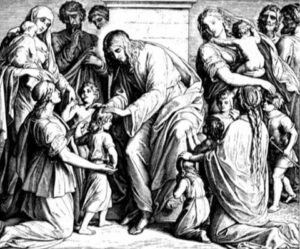
The stories involving children and Jesus provided by the various Gospel writers take another tack. Matthew 19:13-15, Mark 10:13-16, and Luke 18:15-17 all relate a story about people bringing children to Jesus to be blessed. In all three versions the disciples rebuke the people bringing their children to Jesus. In the ancient world, children were on the lowest rung of the ladder in terms of their social ranking. In the eyes of the disciples, therefore, they stand unworthy of Jesus’ attention. Only adults merited his concern.
Jesus responds by embracing the children and exclaiming that no one can enter the kingdom of heaven unless they become like children. In part, Jesus has his eye on a child’s uncomplicated and absolute trust in its parents. It’s the attitude adults should adopt in their relationship to God. The story is a sweet and endearing tableau I remember a Sunday School teacher using to show me how much Jesus loved me, although it mostly made me think of Jesus as Santa Claus listening to a child perched on his knee.
Jesus is also using an actual situation as a teachable moment to illustrate to his disciples what we might call the Principle of Topsy Turvy that frequently appears in his teaching and was clearly dear to his heart: The humble are to be exalted over the proud, the last will be first, and so on. Luke certainly interpreted the story in this way. He carefully sandwiched the story about the children between two other stories where the established order of things is reversed (humble/proud in Luke 18:10-14 and poor/rich in 18:18-25).
It is interesting to compare references to children in the writings of Saint Paul, who took Christ’s earnest restatement of the Jewish faith and forged from it a new religion. In many respects, Paul’s attitude to children more closely mirrors that of Epictetus than that of the man Paul claims to have encountered on the road to Damascus. In Ephesians 4:14 Paul argues that mature Christians must stop acting like frivolous children and be weaned from childish ways: “We must no longer be children, tossed to and fro and blown about by every wind of doctrine, by people’s trickery, by their craftiness in deceitful scheming. But speaking the truth in love, we must grow up in every way into him who is the head, into Christ….”
The thought is strikingly similar to Epictetus’ denigrating of children as inconstant (Encheiridion 29:3), as they flit from one play role to another since they have not yet adopted a more adult approach to life. Just as Epictetus taught, Paul argues that we must grow up or be weaned in every way and leave the ways of children behind us.
Even more striking is the use of children in Paul’s most famous passage, 1 Corinthians 13:11. “When I was a child, I spoke like a child, I thought like a child, I reasoned like a child; when I became an adult, I put an end to childish ways.”¹
Modern attitudes to children have been profoundly influenced by centuries of Christian thought, especially in the teachings of Jesus himself.² Children, for many in Western societies, are wide-eyed innocents, characterized by unwavering faith in their parents, and somehow free initially from the sins and shortcomings that afflict the human condition. Epictetus, like St. Paul, appraised children in a much different, more realistic manner.
In a nutshell, Epictetus’ message is clear: Just grow up! Stoic discipline provides us with a reasonable solution to the bugbears and fears that afflict us all, a solution based firmly upon rational thought and common sense.
On a personal note, I hope the articles I’ve shared don’t come across as overly academic. For me they are not. Instead, they reflect my own journey from a life of faith and revealed religion to a life based on reason and the human experience we all share in our common journey through life and death.
In a future article (Epictetus Renders unto Caesar), we’ll take a look at Stoicism and politics. Stoic teaching provides a useful and increasingly necessary alternative to polarized political thought in an age of dogmatic extremism.
1. See also 1 Corinthians 3:1 and 14:20.
2R. Renner. Das Kind: Ein Gleichnismittel bei Epiktet. 1905.