
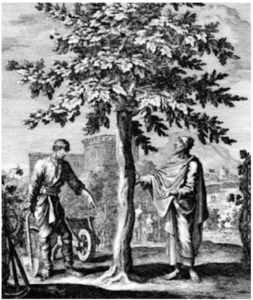
Jesus often employed illustrative parables in his teachings, but he was not, in fact, the only spiritual or philosophical figure who adopted parable as an important teaching tool.1 Epictetus (55-135 C.E.) frequently used parable or parable-like examples in both the Discourses and the Enchiridion.
Like Jesus, Epictetus looked to the everyday objects and activities of his culture to illustrate his teachings in a vivid way. Jesus, as a typical first century Palestinian, often turned to the rustic, agricultural, or familial realms for his parables. Epictetus, an educated inhabitant of Imperial Rome teaching upper-class young men, more often drew his examples from urban commonplaces more familiar to that select audience: politics, banquets, athletics, public baths, military service, sea-faring, and so on.
Epictetus did occasionally make use of agricultural parables or examples. An excellent example is found in the Discourses 1.15:6-8 where Epictetus uses the fig tree in a striking way to make a point about the value of patience. Jesus himself used the fig tree more than once in his teachings,2 including, of course, the so-called Parable of the Barren Fig Tree (Luke 13:6-9). A comparison of the fig tree parables illustrates an interesting contrast between the mindsets of Epictetus and Jesus. Let’s look at the texts3 first.
Discourses 1.15:6-8
When someone who was seeking advice asked, “I am seeking this one thing, namely, how I might be in accordance with nature, even though [my brother] and I are at odds.”
He [Epictetus] replied, “Nothing great comes about instantly, indeed, not even4 a cluster of grapes or a fig. If you were to say to me now, ‘I want a fig,’ I would reply to you, ‘That takes time.’
“Let [the fig tree] bloom first, produce fruit, and then ripen. And so, although a fig’s fruit does not come about all at once and in a single hour, why do you still wish to obtain the fruit of a person’s mind quickly and easily? Even if I myself were to tell you it is possible, don’t you believe it!”
Luke 13:6-9
And he [Jesus] said this parable:
Someone had a fig tree that had grown in his vineyard, and he came seeking fruit on it and found none.
And he said to the vinedresser, “Look, I’ve been coming for three years seeking fruit on this fig tree and I find none. So cut it down. Why waste ground on it?”
[The vinedresser] responded to him: “Sir, leave it be for one more year until I dig around it and provide manure. Perhaps it will produce fruit in the coming year. But if not, cut it down.”
At first glance, the two texts share some characteristics:
- The stories are both spoken to a group of disciples or students
- Both stories provide a moral lesson
- Both stories use an agricultural metaphor to relate the moral lesson
But a closer examination reveals some key differences.
The theme that underlies the fig tree parable in Luke ultimately reflects an apocalyptic Christian mindset firmly based in a vision of judgment for the unworthy or unrepentant. The belief that judgment and destruction are imminent for those who do not produce fruit for the Kingdom of God colors the New Testament parable. The owner of the vineyard may, indeed, be persuaded to wait one more year, but the stay is temporary. The stark threat of destruction ends the parable on a ominous note.
Epictetus, on the other hand, uses the fig tree as an example, taken from nature, of the need for a patient, persistent, even life-long struggle to attain the Stoic ideal. For Epictetus, the beginning of philosophy arises when we become aware of our own weakness and impotence with respect to what really matters in life (Discourses 2.11:1-2). From that moment on, it becomes a matter of committing ourselves to living as rational adults and making progress by applying the principles of Stoicism in a disciplined and ongoing way (Enchiridion, 51:2). And we might say with Epictetus: That takes time.
The contrast between the two mindsets could hardly be more striking.
In a future issue, we’ll take a look at how children figure as symbols in the teachings of Epictetus and Jesus. On the subject of children, the contrast between the two teachers is even more pronounced.
Footnotes:
- Although parables are often defined as stories or fictional narratives, the Greek and Hebrew words for parable are not that restrictive. The Greek word for parable, parabolē, simply means comparison, as does the Hebrew word mashal which it translates. This includes short narratives, but also other forms of parabolic speech such as simple analogies and examples. For a fascinating and detailed exploration of parable in the New Testament and elsewhere, see Klyne Snodgrass, Stories with Intent: A Comprehensive Guide to the Parables of Jesus. William B. Eerdmans Publishing Co. 2008. ISBN 978-0-8028-4241-1.
- See Mark 11:12-14 and 11:20-25 where Jesus angrily curses a fig tree for not producing fruit out of season. Luke and Matthew, like most readers today, found this inappropriate. When they made use of Mark’s version, they redacted it to remove any mention of Jesus being angry. Also compare the fig tree parable found in Matthew 24:32-35, Mark 13:28-31, and Luke 21:29-33 where the leafing out of a fig tree (and any tree for that matter) is used as a sign that the Kingdom of God is near.
- For those interested in the original Greek texts, click these links to the source texts at the Perseus Project: Epictetus, Discourses 1.15:6-8 (http://www.perseus.tufts.edu/hopper/text?doc=Perseus:text:1999.01.0235:text=disc:book=1:chapter=15) and Luke 13:6-9 (http://www.perseus.tufts.edu/hopper/text?doc=Perseus:text:1999.01.0155:book=Luke:chapter=13:verse=6).
- Not even: Epictetus elsewhere uses figs as examples of something trivial, or relatively worthless that should not be squabbled over, as children might fight over dried figs and nuts. See Discourses 4.7:22.
- Even the Greek verb translated as cut down may reflect this. It also means to exterminate, raze, or root out. It is not a colorless word.
- Marcus Aurelius (II, 7.3) went so far as to declare that life is war. It’s the practical, ongoing exercise or discipline (askēsis) of Stoic philosophy alone that can escort us safely through that battlefield. See Meditations II, 17.3.